
The Complete Guide to a Vietnam Motorbike Trip (2026 Edition)

 https://images.prismic.io/natouris/afZngcBOoF08xjas_TheCompleteGuidetoaVietnamMotorbikeTrip.webp?auto=format,compress&rect=0,17,1000,525&w=1200&h=630
There are trips you plan, and then there are trips that rewire you. A Vietnam motorbike trip is firmly in the second category. Picture this: a 125cc semi-automatic humming between your knees, a mountain pass dissolving into cloud, a rice paddy glowing neon green, and nothing between you and the country but a helmet and the open road. Vietnam on two wheels isn't just a travel style. It's the single most immersive way to experience a country that has been seducing adventurers for decades. This guide covers everything, from Vietnam motorbike rental and route planning to safety, legality, gear, and the real costs. Whether you're a first-timer or returning addict, read this before you twist that throttle.
Why Vietnam Is the World's Greatest Motorbike Country
It starts with the geography. Vietnam is a narrow S-shaped country, roughly 1,650 kilometers from tip to tip, blessed with coastlines, mountain ranges, river deltas, and dense highland jungle. No single road can connect all of it. No train reaches the passes. No bus takes you through the villages where real life is happening.
The motorbike culture here isn't a tourist gimmick either. Vietnam has over 70 million registered motorbikes. The two-wheeler is the national vehicle, the family car, the delivery truck, the moving van. When you ride here, you're not performing adventure tourism. You're joining the daily rhythm of the country.
And the routes? Let's just say Vietnam's road designers accidentally created the world's greatest motorbike itinerary.
The Best Vietnam Motorbike Routes (And How to Choose)
The Ha Giang Loop: Vietnam's Most Iconic Ride
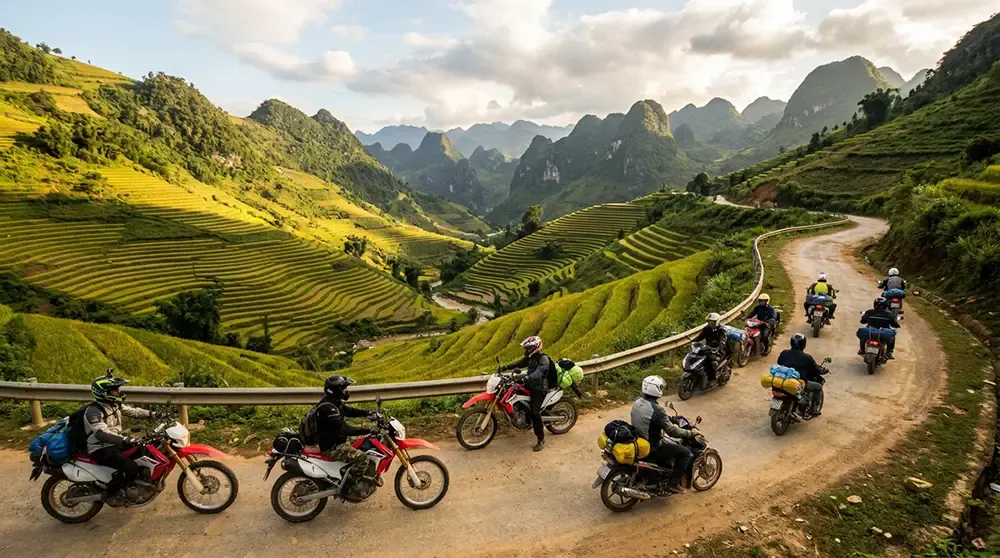
If you talk to anyone who's done a Vietnam motorbike tour, the Ha Giang Loop comes up within thirty seconds. Located in the far north, near the Chinese border, this circuit through Dong Van Karst Plateau Global Geopark is genuinely unlike anything else on earth.
The loop typically runs 350-500 kilometers over 3-5 days, passing through the Mã Pí Lèng Pass (one of Southeast Asia's most spectacular mountain roads), ethnic minority markets, and villages perched impossibly on limestone cliffs.
What makes it special:
- The Mã Pí Lèng Pass drops sharply to the Nho Que River, an impossibly blue-green slash through grey rock.
- Saturday markets in Đồng Văn and Mèo Vạc offer authentic cultural encounters you can't manufacture.
- The loop is doable solo or with an "Easy Rider" guide, though first-timers should strongly consider a guide.
Permit note: Ha Giang requires a permit for foreign nationals. Your guesthouse in Ha Giang city can arrange it for roughly $1-2 USD. Don't skip this.
The Hai Van Pass: Short, Spectacular, Non-Negotiable
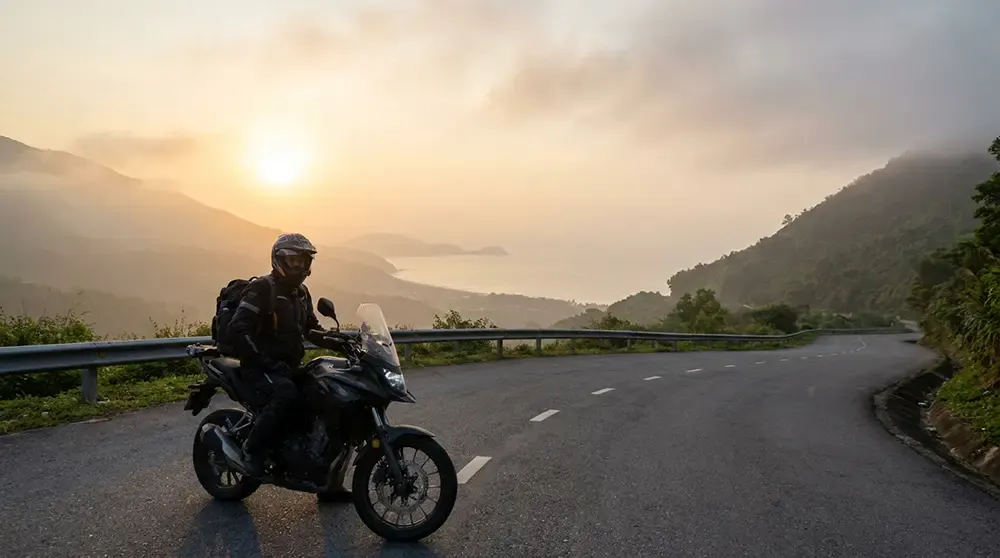
The Hai Van Pass, between Da Nang and Hue, is one of those rides you'll replay in your head for years. It's only 21 kilometers, but the views from the summit, looking out over Da Nang Bay on one side and Lang Co lagoon on the other, are legitimately jaw-dropping.
This is the route made famous by Jeremy Clarkson and the Top Gear Vietnam special. That episode aired in 2008. The pass is still worth it, possibly more so now that the new highway tunnel has diverted truck traffic off it.
Riding time: 1-2 hours. Works perfectly as a day trip from Hoi An or Da Nang, or as a segment of the bigger north-south journey.
The Ho Chi Minh Road: The Road Less Ridden
While the coastal Highway 1 is faster, the Ho Chi Minh Road (Highway 14) is better. Running through the Central Highlands from north to south, it passes through Phong Nha, coffee plantations in Buon Ma Thuot, and quiet highland towns where foreigners are still a novelty.
If you have 14+ days and want a Vietnam motorbike adventure that feels genuinely off the tourist circuit, this is your road.
Ho Chi Minh City to Hanoi: The Classic South-to-North
The full coast-to-coast, south-to-north journey is the Vietnam motorbike trip that gets talked about in hostels from Lisbon to Seoul. Most riders do it in 10-21 days, with the sweet spot being around 14 days if you want to actually see things rather than just cover kilometers.
Recommended direction: South to north. The winds and weather patterns tend to cooperate better, and you end in Hanoi, which has better connections for selling or returning your bike.
Vietnam Motorbike Route Comparison Table
| Route | Distance | Difficulty | Duration | Best For |
|---|---|---|---|---|
| Ha Giang Loop | 350-500km | Hard | 3-5 days | Adventure seekers, mountain lovers |
| Hai Van Pass | 21km | Easy | Half day | All skill levels, day-trippers |
| Ho Chi Minh Road (full) | ~1,800km | Moderate-Hard | 10-14 days | Experienced riders wanting solitude |
| HCM City to Hanoi (coastal) | ~1,750km | Moderate | 10-21 days | First-time long-distance riders |
| Hoi An to Hue | ~120km | Easy-Moderate | 1 day | Short-trip riders, beginners |
| Dalat to Nha Trang | ~130km | Moderate | 1-2 days | Mountain-to-coast scenery fans |
Should You Buy or Rent a Motorbike in Vietnam?
This is the debate that fills travel forums. Here's the honest breakdown.
Vietnam Motorbike Rental
Renting is the right call if you're riding for fewer than 3 weeks, sticking to one region, or unsure about your mechanical competence. Daily rental costs run $5-15 USD for automatic bikes and $8-20 USD for manual semi-automatics. The popular Honda Win and Yamaha Exciter dominate the rental market.
Reputable rental shops in Hanoi include Tigit Motorbikes and Flamingo Motorbikes. In Ho Chi Minh City, check Saigon Motorbike Tours. These shops typically provide helmets, basic documentation, and sometimes a lock.
Rental pros: No resale stress, maintenance often covered, flexible. Rental cons: Daily costs add up, some contracts have fine-print damage clauses, limited customization.
Buying a Motorbike in Vietnam
If you're riding for 3+ weeks or doing the full north-to-south journey, buying makes financial sense. The used motorbike market in Vietnam is active and accessible to foreigners. Expect to pay $150-400 USD for a rideable Honda Win or semi-auto, and $300-600 for a more reliable semi-automatic in better condition.
The most popular buyers' markets are at Hanoi's Xuan Dieu Street and the Facebook groups "Vietnam Backpacker Motorbikes" and "Hoi An Motorbike Backpackers."
You can then sell the bike at the end of your trip, often recouping 60-80% of your cost.
Buying pros: More economical long-term, freedom, no daily rental anxiety. Buying cons: Title transfer complications (bikes are often sold without formal title), breakdown responsibility is yours.
What Type of Motorbike Should You Get?
For Beginners: Automatic Scooter
If you've never ridden before or only have scooter experience, stick with an automatic. The Honda Vision and Yamaha Janus are smooth, reliable, and handle most roads fine. They're not ideal for the Ha Giang Loop's steep grades, but they'll get you through 90% of Vietnam's roads without drama.
For Intermediates: Semi-Automatic (The Sweet Spot)
The Honda Win is Vietnam's unofficial mascot. It's a semi-automatic with a clutch but no gear shifter in the traditional sense. You pull the clutch, click through the gears with your foot. It's learnable in an afternoon and gives you much more control on mountain roads. Downside: the Win is old technology, and breakdowns happen. Every mechanic in Vietnam can fix one in twenty minutes, which is either reassuring or telling, depending on your perspective.
For Experienced Riders: Manual 150cc+
If you have real motorbike experience, consider a Honda XR150, Royal Enfield Himalayan (available for rent in some cities), or a Yamaha WR155 for the mountain routes. The extra power matters when you're climbing 10% grades at altitude with luggage.
Engine size guidance:
- City and flat roads: 110-125cc automatic is fine.
- Mountain passes (Ha Giang, Ho Chi Minh Road): 125cc semi-auto minimum, 150cc preferred.
- Loaded touring with luggage: 150cc+.
Vietnam Motorbike Trip Cost Breakdown
The motorbike Vietnam cost question has a huge range. Here's a realistic breakdown for a 14-day south-to-north trip.
| Expense | Budget | Mid-Range | Comfort |
|---|---|---|---|
| Motorbike (buy + resell) | $80-150 net | $100-200 net | $150-300 net |
| Fuel (14 days) | $30-50 | $30-50 | $30-50 |
| Accommodation (per night) | $5-10 | $12-25 | $30-60 |
| Food (per day) | $5-8 | $10-20 | $20-40 |
| Repairs and maintenance | $20-50 | $20-50 | $20-50 |
| Activities and entrance fees | $20-40 | $50-100 | $100-200 |
| Travel insurance | $30-60 | $60-100 | $100-200 |
| Total (14 days) | $450-650 | $700-1,200 | $1,200-2,500 |
Fuel costs are remarkably stable because Vietnamese petrol prices are government-regulated and a 125cc bike gets roughly 40-50 kilometers per liter. You're looking at roughly $3-5 USD per 100 kilometers of riding.
For a deeper look at budgeting your Asia travel, our budget travel guide to Southeast Asia has solid context on what your money gets you across the region.
Vietnam Motorbike Safety: The Honest Truth
Let's not sugarcoat it. Vietnam's roads are genuinely dangerous. The World Health Organization consistently ranks Vietnam among countries with high road traffic mortality rates. Traffic moves fast, road conditions are unpredictable, and the driving culture operates on different logic than what most Western riders are used to.
But "dangerous" is relative. Thousands of travelers ride Vietnam every month without incident, because they take the right precautions.
Vietnam Motorbike Safety Tips
Before you ride:
- Practice in a quiet area before hitting traffic. Hanoi and Ho Chi Minh City traffic is genuinely overwhelming for first-timers.
- Always wear a full-face helmet. The cheap half-shell helmets sold everywhere offer minimal protection. Bring your own or buy a quality one locally (AGV and Yohe brands are available in Vietnam for $30-60).
- Get proper riding gear. At minimum: riding jacket, gloves, and sturdy shoes. Sandals and a tank top look cool right up until the moment they don't.
On the road:
- Ride defensively. Assume vehicles will pull out, merge, or stop without warning.
- Avoid night riding whenever possible. Poorly lit roads, unmarked hazards, and the occasional unlit vehicle make night riding significantly more dangerous.
- Watch for wet painted road markings, which become ice-slick in rain.
- Give trucks and buses serious room. They won't.
Most dangerous situations:
- The Ha Giang mountain passes after rain (loose gravel, mud, zero guardrails).
- Night riding anywhere on Highway 1.
- The Ho Chi Minh City and Hanoi rush hours, until you know the traffic logic.
Vietnam Motorbike License and Legal Requirements
This is where most guides are annoyingly vague. Here's the reality.
Do You Need a License?
Technically, yes. To legally ride a motorbike above 50cc in Vietnam, you need either a Vietnamese driving license or an International Driving Permit (IDP) with a Category A motorcycle endorsement. The IDP must be obtained in your home country before travel.
The Enforcement Reality
In practice, police checkpoints are inconsistent. Many riders go weeks without being stopped. When they are stopped, the usual outcome for tourists is a small unofficial "fine" of $5-20 USD, paid on the spot.
However, enforcement has tightened in recent years, particularly around Ha Giang (given the volume of foreign riders) and in major cities. Getting caught without documentation isn't catastrophic, but it's avoidable stress.
The smart approach:
- Get an IDP before you leave home. In the US, the AAA issues them for $20. In the UK, the RAC or Post Office handles them. They take minutes and cost almost nothing.
- Carry your passport and IDP at all times on the road.
- Know that your IDP may not technically be valid for Vietnamese roads per local law, but it signals legitimacy at checkpoints.
Can Foreigners Legally Own a Motorbike?
This is where it gets complicated. Foreigners technically cannot hold a Vietnamese vehicle title in their name. The used motorbike market operates on informal "hand notes" rather than formal title transfers. This is normal, widely accepted, and how the backpacker motorbike ecosystem has functioned for decades.
Travel Insurance for a Vietnam Motorbike Trip
This section matters more than most people realize. Standard travel insurance policies almost universally exclude motorbike accidents, either entirely or unless you hold a valid local license.
What you need:
- A policy that explicitly covers motorbike riding. Read the exclusions section before buying.
- World Nomads and SafetyWing are the most commonly recommended options for motorbike travelers in Southeast Asia, though policies change, so always confirm coverage details directly.
- Make sure your policy covers medical evacuation, which can cost tens of thousands of dollars if you need helicopter extraction from somewhere like Ha Giang.
The blunt truth: if you're riding without appropriate insurance and you have a serious accident, the financial consequences can be life-altering. Don't skip this.
What to Pack for a Vietnam Motorbike Trip
Packing for a motorbike trip requires a different mindset than normal travel. Everything goes on the bike, usually in a dry bag or tail bag strapped to the rear rack.
Essential Gear
- Full-face helmet (non-negotiable)
- Riding gloves (waterproof preferred)
- Lightweight riding jacket with CE-rated armor
- Rain gear, specifically a two-piece rain suit, not a poncho (ponchos catch wind catastrophically at speed)
- Sturdy closed-toe shoes or riding boots
- Sunglasses or visor tint for daytime glare
Electronics and Navigation
For navigation, Google Maps works well on Vietnam's main routes. For the Ha Giang Loop and more remote areas, download offline maps via Maps.me or OsmAnd before you leave connectivity. Garmin GPS units are overkill for most routes but used by some long-distance riders.
A handlebar phone mount and a good power bank are essential. Vietnam's mountain regions mean long stretches without charging opportunities.
For more on the apps that actually make a difference in Asia travel, check our essential Asia travel apps guide.
Medical and Repair
- Small first aid kit including wound wash, bandages, and antiseptic cream.
- A basic tool kit: tire levers, puncture repair kit, spare inner tube, and a pump.
- Chain lube (roads get dusty, chains dry out fast).
- The phone number of your rental shop or a trusted mechanic.
How to Handle a Motorbike Breakdown in Vietnam
Breakdowns are part of the deal. The good news is that Vietnam's roadside mechanic network is extraordinary. In most populated areas, you're never more than a few kilometers from a xe om (motorbike repair) shop, identifiable by bikes parked outside and a tire pump visible from the road.
What to do:
- Pull over safely. Don't stop on blind corners or active highway lanes.
- Assess the problem. Flat tire, dead battery, engine cut-out, and chain issues are the most common.
- Push or flag down help. Vietnamese people are generally genuinely helpful to stranded motorbike travelers. Point to the bike and mime confusion; someone will understand.
- Negotiate price before the work begins. Repairs should cost $1-10 for most standard fixes.
- If rural and truly stuck, the rental shop or your guesthouse's contact can often arrange transport or remote guidance.
Carrying a photographed copy of your rental agreement (or the bike's details) helps mechanics identify parts quickly.
Best Time for a Vietnam Motorbike Trip
Vietnam's climate splits roughly into three zones with different wet seasons. Getting the timing right is crucial.
North Vietnam (Hanoi, Ha Giang)
- Best months: October to April.
- Avoid: May to September (heavy monsoon rains, flooding, landslides in mountain areas).
- Peak season: October and November offer clear skies and cooler temperatures, ideal for Ha Giang.
Central Vietnam (Hai Van Pass, Hue, Hoi An, Da Nang)
- Best months: February to August.
- Avoid: September to January (typhoon season, heavy rainfall, particularly October-November).
- Note: The central region's wet season is offset from the north and south.
South Vietnam (Ho Chi Minh City, Mekong Delta)
- Best months: November to April (dry season).
- Avoid: May to October (rainy season, though rain is often short-burst afternoon showers rather than all-day events).
The Full North-to-South Timing Sweet Spot
If you're doing the whole country, February to April is generally considered the best window. The north has dried out from winter, the central coast is in its dry window, and the south is wrapping up dry season.
Vietnam Motorbike Itinerary Options
7-Day Vietnam Motorbike Itinerary (Ha Giang Focus)
| Day | Route | Distance |
|---|---|---|
| 1 | Hanoi arrival, bike pickup, city orientation | - |
| 2 | Hanoi to Ha Giang | 320km |
| 3 | Ha Giang to Dong Van via Quan Ba Pass | 150km |
| 4 | Dong Van to Meo Vac via Ma Pi Leng Pass | 50km |
| 5 | Meo Vac to Bao Lac | 75km |
| 6 | Bao Lac to Ha Giang | 200km |
| 7 | Ha Giang to Hanoi, bike return | 320km |
14-Day Vietnam Motorbike Itinerary (Central Coast)
Best done south to north, starting in Da Nang and riding to Hanoi with stops in Hue, Phong Nha, Ninh Binh, and a detour to Ha Giang if time allows.
21-Day Full Country Itinerary
Ho Chi Minh City to Hanoi, mixing the coast and the highlands, with the Ha Giang Loop as the northern finale. This is the trip people write blogs about for years afterward.
Navigating Vietnam by Motorbike: Apps and Tools
Google Maps handles Vietnam's roads well, including real-time traffic in cities, but its offline functionality requires pre-downloading specific regions. Maps.me has better offline performance and includes detailed rural tracks. For the Ha Giang area specifically, some riders swear by OsmAnd for its accuracy on smaller mountain roads.
A few practical tips:
- Download offline maps before leaving any city. Mountain regions have patchy or non-existent data coverage.
- Set your Google Maps to "avoid tolls" and "avoid highways" to get routed on the more interesting back roads.
- The "Vietnam Motorbike Community" Facebook group is an excellent resource for real-time road condition reports.
The Ha Giang Loop: Is It Worth It?
Short answer: yes, unconditionally, if you have the riding ability and time.
The slightly longer answer: Ha Giang is genuinely challenging. The roads include sections of loose gravel, steep grades, blind hairpin turns, and near-zero guardrails above vertical drops. It is not suitable for complete beginners, automatic-only riders, or anyone uncomfortable with unpaved surfaces.
That said, the scenery is so absurdly spectacular that experienced riders consistently call it the highlight of not just their Vietnam motorbike trip but of their entire traveling lives.
Self-ride vs. guided tour:
- Self-ride gives you flexibility and the full adventure.
- A "Easy Rider" guide from Ha Giang city is recommended for first-timers. Guides know the roads, speak some English, can handle mechanical issues, and provide genuine cultural context that you'd miss solo.
- Guided loop tours run $30-60 USD per day including guide, accommodation, and meals. Not cheap by Vietnamese standards, but fair value.
Solo Motorbike Travel in Vietnam: What to Know
Solo riding in Vietnam is common and manageable. The backpacker infrastructure is well-established, guesthouses are used to solo motorbike travelers, and the rider community is genuinely social. You'll rarely feel truly alone.
Practical solo considerations:
- Tell your guesthouse your planned route each morning. Someone should know roughly where you're heading.
- Share your GPS location with a trusted contact back home when riding remote areas.
- Breakdowns alone are more stressful but manageable. The mechanic network and the kindness of locals means you're rarely stuck for long.
- Carry enough cash. Rural ATMs are rare and unreliable.
If you're newer to solo adventure travel in Asia, our guide on best Asian countries for first-time solo travelers provides useful regional context.
Frequently Asked Questions
Is it safe to ride a motorbike in Vietnam as a tourist? It's manageable with the right preparation. Wear proper gear, get an IDP, ride defensively, avoid night riding, and get real insurance. Hundreds of thousands of tourists ride Vietnam each year. The risk isn't zero, but it's also not the reckless gamble some people imagine.
How long does it take to ride from Hanoi to Ho Chi Minh City? The straight coastal route (Highway 1) covers roughly 1,750 kilometers. Riders covering 150-200km per day average 10-14 days riding time. Add stops, detours, and recovery days and most travelers budget 15-21 days for the full journey.
Do I need a Vietnamese driving license? Technically yes for bikes above 50cc. An IDP from your home country is the practical solution most travelers use. Get one before your trip.
What's the cheapest way to do a Vietnam motorbike trip? Buy a used Honda Win (budget $150-250), camp or stay in dorm hostels, eat from street stalls (meals for $1-2 USD), and sell the bike at the end. Twelve to fourteen days can be done for under $500 total.
Final Thoughts: The Ride You'll Never Forget
There's a specific moment that happens on a Vietnam motorbike trip, somewhere between a mountain pass and a valley descent, when the country just opens up in front of you. No filter, no tour bus window, no curated itinerary. Just road, landscape, and the feeling that you chose this. That feeling is worth every kilometer of planning.
Start with the Ha Giang Loop if you want the mountain version. Do the Hai Van Pass if you're short on time. Commit to the full south-to-north if you have three weeks and want to understand what "transformative travel" actually means rather than reading about it.
Get your IDP sorted. Find proper insurance. Wear the gear. Download the offline maps. And go. Vietnam by motorbike is the trip that keeps demanding you come back.
Ready to plan your route? Drop your questions in the comments or share your own Vietnam ride stories. And if you're in the early stages of planning a broader Southeast Asia adventure, our budget travel guide to Southeast Asia is a solid next stop.
Share this article