
Sri Lanka Tuk-Tuk Adventure: 7-Day Journey Guide

 https://images.prismic.io/natouris/aYcyht0YXLCxViZh_SriLankaTuk-TukAdventure7-DayJourneyGuideThumbnail.webp?auto=format,compress&rect=0,17,1000,525&w=1200&h=630
A Sri Lanka tuk-tuk adventure transforms how you experience the teardrop isle. Unlike standard tours, a tuk-tuk tour Sri Lanka puts you behind the handlebars of a three-wheeled vehicle, cruising at 40 km/h through jungle villages, tea plantations, and coastal roads most tourists never see. This Sri Lanka road trip tuk-tuk guide covers everything: costs (around $3,050 USD for 7-10 days), the best tuk-tuk adventure Sri Lanka itinerary from Sigiriya to Pasikuda Beach, safety considerations, and booking strategies. Whether you're planning a Colombo tuk-tuk tour or a multi-day tuk-tuk trip Sri Lanka, this comprehensive guide reveals why slowing down might be the best travel decision you'll ever make.
If you're wondering whether Sri Lanka is safe for this kind of adventure, our complete safety guide covers everything you need to know.
What if I told you the best way to see Sri Lanka isn't through a tour bus window or from a luxury train car, but from behind the handlebars of a three-wheeled vehicle that maxes out at 40 km/h?
A Sri Lanka tuk-tuk adventure isn't just transportation. It's an invitation to slow down, meet locals selling durian by the roadside, navigate 18 hairpin turns through misty mountains, and discover why getting hopelessly lost might be the best thing that happens to your trip.
This isn't the Sri Lanka you see on Instagram. This is the version where you buy petrol from liquor bottles, learn to make fish curry in a stranger's kitchen, and realize that the journey, not the destination, was always the point.
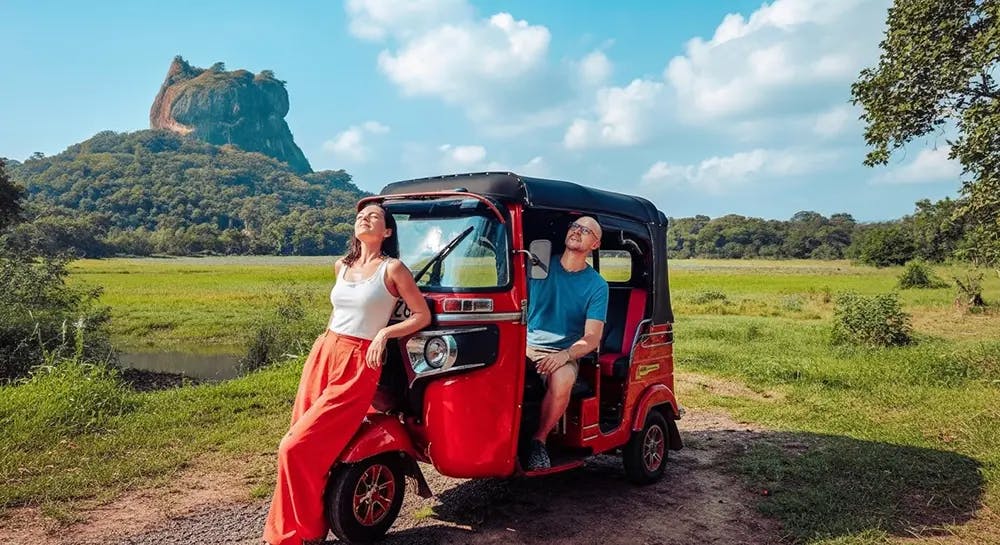
What Is a Sri Lanka Tuk-Tuk Adventure?
Think of it as a road trip, but exponentially more intimate. You're not cruising through Sri Lanka in an air-conditioned SUV. You're rattling through jungle villages at a pace that forces you to notice everything: the smell of fresh tea leaves, the sound of monks chanting from temples, the wave from a farmer who thinks you're completely insane for driving that thing.
A tuk-tuk tour Sri Lanka experience typically involves driving these iconic three-wheeled vehicles yourself. No chauffeur. No script. Just you, a map (that you'll probably ignore), and the freedom to pull over whenever something catches your eye.
While tuk-tuks offer unmatched flexibility, comparing transport options can help you decide if this is right for you.
The vehicles are simple. Manual transmission, handlebar steering, and about as much horsepower as a determined house cat. But they're perfect for this landscape, narrow enough to squeeze through village roads that tour buses can't touch, slow enough that you actually experience the places you're passing through.
The Route: Where This Sri Lanka Road Trip Tuk-Tuk Takes You
Most tuk-tuk adventure Sri Lanka itineraries follow a similar arc, threading through three distinct climate zones in a single week. You'll start in the Cultural Triangle around Sigiriya, climb into the misty Hill Country, and finish on the pristine East Coast beaches.
Day 1-2: Kandalama (Cultural Triangle)
Your base near Kandalama Lake, where you'll spend two days getting comfortable with your tuk-tuk. The training happens on a dry lakebed, which sounds dramatic until you realize it's basically a massive, bumpy parking lot. But it works. By day two, you'll be tackling Pidurangala Rock, the scrappier sibling of famous Sigiriya.
Kandy, another Cultural Triangle gem, offers 20 incredible things to do if you're extending your trip.
Day 3-4: Knuckles Mountain Range
This is where things get interesting. The 18-hairpin-turn road up to the Knuckles is legitimately challenging. Your tuk-tuk will struggle. You might question your life choices. But then you'll arrive at Wild Glamping Knuckles, luxury tents perched in a UNESCO biodiversity hotspot, and it all makes sense.
Day 5: Nuwara Eliya (Hill Country)
Welcome to "Little England," where the air smells like fresh tea and the mist never quite lifts. You'll visit a converted 1870s tea factory, learn the difference between BOP and BOPF tea grades, and possibly make fish curry with strangers you just met.
For a deeper dive into Ceylon tea culture, explore our complete plantation tours guide.
Day 6-7: Pasikuda Beach to Sigiriya
The final stretch takes you from mountain chill to coastal heat. You'll plant coconut trees, run out of gas (twice, probably), and end where you started, completing a full circle that somehow feels like you've traveled much farther than the actual kilometers suggest.
How Much Does a Tuk-Tuk Adventure Cost?
Let's talk numbers. A properly organized tuk-tuk tour Sri Lanka package through operators like Large Minority runs around $3,050 USD per person for 10 days and 9 nights. That's based on double or triple occupancy.
What's Included:
- Tuk-tuk rental and driving lessons
- All accommodations (ranging from 4-star hotels to luxury glamping)
- Most dinners and breakfasts
- Support vehicles (mechanics, luggage truck)
- Cultural challenges and activities
What's Not:
- International flights
- Visa fees (approximately $50 USD)
- Lunches and some dinners
- Personal expenses
Is it budget travel? No. But consider what you're getting: a vehicle, comprehensive training, carefully selected unique accommodations, and the logistical support that means you're never truly stranded when you inevitably run out of gas in the middle of nowhere.
For comparison, a standard 7-day Sri Lanka tour with a driver typically costs $1,500-$2,500 per person, but you're passive. You're being shown Sri Lanka. With a tuk-tuk adventure, you're discovering it yourself.
Are Tuk-Tuk Tours Safe in Sri Lanka?
The short answer: surprisingly, yes. The long answer requires some context.
Sri Lankan roads can be chaotic. Buses don't slow down for much. Trucks materialize out of monsoon mists. Dogs have a death wish. But tuk-tuks have a strange advantage: they're so slow and maneuverable that you're rarely in situations where speed matters.
Safety Factors:
- Support Network: Organized tours include mechanics ("wrench lords") who shadow the group
- Route Planning: Best tuk-tuk routes Sri Lanka operators choose roads that balance adventure with manageable traffic
- Training: You'll spend 1-2 days learning to drive before hitting public roads
- Community: Traveling in a group means someone always has your back
The biggest danger isn't traffic. It's overconfidence. The moment you start feeling like a pro, you'll encounter a water buffalo blocking the entire road or realize you're driving on the wrong side because you got distracted by a roadside vendor selling something mysterious and delicious.
Do You Need a License to Drive a Tuk-Tuk in Sri Lanka?
Technically, yes. Practically, it's complicated.
If you're on an organized tour, operators usually handle the paperwork. Your regular driver's license from home, combined with an International Driving Permit (IDP), should suffice for most situations.
For solo tuk-tuk rental Sri Lanka adventures, requirements get stricter. Some rental companies insist on seeing an IDP. Others are more flexible if you're staying within tourist areas.
The Reality:
Police checkpoints do happen, but tourists in tuk-tuks are generally given more leeway than locals. That said, having an IDP is cheap ($20 from AAA) and eliminates any ambiguity. Get one before you leave home.
Best Time for Tuk-Tuk Adventures in Sri Lanka
Sri Lanka has two monsoon seasons that affect different parts of the island at different times. For a route that covers the Cultural Triangle, Hill Country, and East Coast, you want April or July.
April: The Sweet Spot
The entire island generally has good weather before the Southwest monsoon arrives in late May. Temperatures are warm but not oppressive. Roads are dry. Tea plantations are lush.
July: East Coast Prime Time
The East Coast (Pasikuda, Arugam Bay) has its dry season from May to September. While the Hill Country might be misty and cool, the Cultural Triangle and beaches will be sunny.
Our month-by-month guide to visiting Sri Lanka provides detailed weather patterns and regional variations.
Avoid: October-November
The inter-monsoon period brings unpredictable heavy rain across the entire island. Can tuk-tuks handle monsoon weather? Technically yes. Should you want to? Absolutely not.
Weather Comparison Table:
| Month | Cultural Triangle | Hill Country | East Coast | Tuk-Tuk Suitability |
|---|---|---|---|---|
| April | Excellent | Good | Good | Ideal |
| July | Excellent | Misty/Cool | Excellent | Ideal |
| October | Rainy | Very Rainy | Moderate | Not Recommended |
| December | Good | Cool/Misty | Rainy | Moderate |
What to Pack for a Multi-Day Tuk-Tuk Trip Sri Lanka
Space is limited. Your luggage travels in a support vehicle, but you'll want a day bag for essentials. Pack smart, not heavy.
Absolute Essentials:
- Sunscreen (SPF 50+): You're exposed for hours daily
- Sunglasses and a hat with a chin strap
- Light rain jacket: Weather changes fast in the mountains
- Closed-toe shoes: Flip-flops are tempting but impractical
- Cash: Many roadside vendors don't take cards
- Basic first aid kit: Band-aids, pain relievers, anti-diarrheal meds
Traveling through Asia? Our essential travel gear guide covers must-have items for Southeast Asian adventures.
Nice to Have:
- GoPro or action camera for hands-free filming
- Portable phone charger: GPS drains batteries
- Light scarf or bandana: Dust protection on dry roads
- Reusable water bottle: Staying hydrated is critical
Don't Bother:
- Heavy camera gear: Your phone is probably enough
- Formal clothes: Even "nice" dinners are casual
- Too many outfit changes: You'll wear the same comfortable clothes repeatedly
The Hidden Gems: What Makes This Different from Standard Tours
Every Colombo tuk-tuk tour or Ella tuk-tuk tour hits the famous spots. That's not what makes a multi-day adventure special. It's the unplanned moments.
Cultural Immersion You Can't Manufacture:
The "Short Eats" challenge on Day 3 forces you to approach locals, ask questions through gestures and broken Sinhala, and eat foods you've never heard of. One couple ended up helping a durian vendor for an hour, learning that he'd been selling fruit at the same spot for eight years.
The Fish Curry Challenge on Day 5 is even better. You're given 2,500 rupees (about $8 USD) and a shopping list. Find the ingredients. Find a family willing to teach you. Cook in their kitchen. It sounds impossible until you remember that Sri Lankans are almost aggressively hospitable.
One group stumbled into a small Chinese restaurant, communicated through Google Translate, and ended up learning to make Malu Mirisata from scratch while the power was out, the chef holding an LED light over the stove.
Authentic Sri Lankan Fish Curry (Malu Mirisata) Ingredients:
- 500g firm fish (Tuna, Sailfish, or Seer)
- Roasted chili powder, turmeric, black pepper
- Red onion, garlic, green chilies
- Curry leaves (Karapincha), Pandan leaf (Rampe)
- 2-3 pieces Goraka (dried Gambooge, the secret sour agent)
- Coconut oil, fenugreek seeds, mustard seeds
- Fresh coconut milk (thick and thin)
Discover 15 must-try Sri Lankan dishes beyond fish curry in our complete food guide.

Accommodation Spotlight: Where You'll Actually Stay
Forget cookie-cutter hotels. The properties on a tuk-tuk safari Sri Lanka route are destinations themselves.
Wild Glamping Knuckles
Located in a UNESCO World Heritage biodiversity hotspot, these aren't your college camping tents. Think luxury canvas structures with proper beds, en-suite bathrooms, and wooden decks overlooking cloud forests.
The site is off-grid (solar power only), which means limited connectivity. That's the point. You'll fall asleep to the sound of streams and wake up to mist rolling over tea plantations. The property offers guided hikes to waterfalls and birdwatching for rare endemic species.
Rating: 4-5 Star Boutique
Unique Factor: You'll transfer from tuk-tuks to 4x4 jeeps for the final ascent because the road is that rough
Best Feature: Silence. Pure, uninterrupted silence except for wind and wildlife
Tea and Experience Factory, Mandaram Nuwara
A converted tea factory from the 1870s that hasn't lost its industrial soul. Original machinery decorates the lobby. Guest rooms occupy what were once processing floors. The infinity pool overlooks terraced tea plantations that seem to extend forever into the mist.
The experience includes a "leaf-to-cup" workshop where you'll don traditional tea plucker gear (surprisingly heavy baskets), learn the difference between white, green, and black tea processing, and taste grades from "Dust Number One" (exported to Middle Eastern markets) to BOPF (Broken Orange Pekoe Fannings, bound for Russia).
Rating: 4-Star
Unique Factor: Afternoon tea featuring arrack cocktails (local coconut sap liquor)
Best Feature: Watching sunrise from your private balcony while tea pluckers work the surrounding hills
The nearby waterfalls around Nuwara Eliya make excellent day trips from these accommodations.
Is This Suitable for Solo Travelers, Couples, or Groups?
Short answer: all of the above. The group dynamic is part of the magic.
Most tuk-tuk tour packages Sri Lanka bring together 6-12 people who've never met. Some are couples. Some are solo travelers. A few might be friends traveling together. By day three, you're a tribe.
For Solo Travelers:
You'll likely share a tuk-tuk with another solo traveler or join a couple. The challenges are designed to break down social barriers quickly. It's nearly impossible to stay a stranger when you're collectively trying to sell jackfruit to confused locals or memorizing Buddhist prayers together.
For Couples:
Driving together either strengthens relationships or reveals fundamental incompatibilities. There's something bonding about navigating hairpin turns while your partner shouts directions from the back seat. Or terrifying. Probably both.
For Families:
Family-friendly tuk-tuk Sri Lanka adventures exist, but check age requirements. Most operators require drivers to be 21+. Some allow children as passengers if they're old enough to safely grip the vehicle during bumpy sections. Not recommended for kids under 10.
Handling Language Barriers and Local Etiquette
Here's what nobody tells you: language barriers make some interactions better.
When you can't rely on words, you communicate through gestures, smiles, and shared laughter at mutual confusion. You'll mime your way through market purchases. Use Google Translate to ask about ingredients. Point at menus and hope for the best.
Useful Sinhala Phrases:
- Ayubowan (Ah-yoo-bo-wan): Hello/Welcome
- Bohoma sthuthi (Bo-ho-ma stu-ti): Thank you very much
- Koccara da? (Ko-cha-ra da): How much?
- Mata therenne ne (Ma-ta te-ren-ne ne): I don't understand
- Karunakarala (Ka-ru-na-ka-ra-la): Please
Etiquette Essentials:
- Remove shoes when entering homes and temples
- Dress modestly at religious sites (cover shoulders and knees)
- Ask permission before photographing people
- Use your right hand for eating and giving/receiving items
- Don't point your feet at people or Buddha images
The good news? Sri Lankans are exceptionally forgiving of tourist fumbles. They'll laugh with you, not at you, when you completely butcher pronunciation.
The Environmental Angle: Eco-Friendly Tuk-Tuk Experiences
Let's be honest. Tuk-tuks aren't exactly electric vehicles. They're small two-stroke engines that burn fuel inefficiently and emit more than their share of hydrocarbons.
But eco-friendly tuk-tuk Sri Lanka experiences can still make sense if the tour operator prioritizes sustainable practices:
What Large Minority Does Right:
- Tree planting ceremonies (King Coconut trees on most tours)
- Partnership with local schools for supply donations rather than just tourist handouts
- Small group sizes that minimize impact
- Accommodation selection that favors locally-owned properties over international chains
- Support vehicles that consolidate luggage, reducing total vehicle count
What You Can Do:
- Carry reusable water bottles and shopping bags
- Minimize single-use plastics
- Support roadside vendors directly rather than convenience stores
- Respect wildlife (no feeding, no harassing for photos)
- Leave accommodations and viewpoints cleaner than you found them
The reality is that any tourism has environmental impact. The question is whether that impact supports local communities and conservation efforts, or just extracts value.
Pidurangala Rock vs. Sigiriya: Which Should You Climb?
If you only have energy for one climb, here's how to choose.
Sigiriya (Lion Rock):
The famous one. Ancient rock fortress built by King Kashyapa in the 5th century. UNESCO World Heritage Site. Features stunning frescoes, the Mirror Wall with ancient graffiti, and the iconic lion paw entrance.
Cost: $30+ entry fee
Crowd Level: Heavy, especially mornings
Difficulty: Moderate (many stairs, but well-maintained)
Best For: History buffs, those who want the classic Instagram shot
Pidurangala Rock:
The scrappier alternative. Originally a monastery where monks relocated when the king claimed Sigiriya. More rugged climb, fewer tourists, and ironically the best view of Sigiriya itself.
Cost: $3-4 entry fee
Crowd Level: Moderate
Difficulty: Harder (boulder scrambling at the top)
Best For: Adventurers, photographers, budget travelers
The Verdict:
Most tuk-tuk adventures include Pidurangala because the challenge fits the trip's ethos better. You're not here for sanitized tourism. You're here for the slightly awkward, mildly terrifying, completely authentic version.
Plus, when you're sitting at the top of Pidurangala looking out at Sigiriya in the distance, surrounded by jungle with wind whipping through your sweat-soaked shirt, you'll understand why the view from somewhere often beats the view from somewhere.
The Emotional Arc: What Nobody Warns You About
Travel articles usually skip this part. But it matters.
Day 1-2: Excitement and Anxiety
Your mind races with questions. What have I gotten myself into? Do I actually want to spend a week in this rattling death trap? The training helps, but you're still nervous.
Day 3-4: Flow State
Something shifts. You stop white-knuckling the handlebars. You start noticing things: the way locals wave as you pass, the smell of rain on hot asphalt, the exact moment when stress disappears into the wind at 40 km/h.
Day 5: Gratitude and Humility
The challenges stop feeling like checkbox exercises and start feeling like privileges. A stranger invites you into their kitchen. Another won't accept payment for chilies. Someone gives you free fish just because. Your heart feels uncomfortably full.
Day 6-7: Melancholy and Nostalgia
You realize this is ending. You've become attached to your tuk-tuk (even though it's not really yours). The strangers you met on Day 1 now feel like old friends. You're already planning the next trip before this one finishes.
This isn't hyperbole. Read traveler reviews. Everyone describes the same emotional trajectory. The trip breaks you open in ways you don't expect.
How to Book Your Sri Lanka Tuk-Tuk Adventure
Most reputable operators book out 6-12 months in advance, especially for peak season (April, July, December-January).
Booking Process:
- Research Operators: Large Minority is the most established, but others exist in Pakistan, Nicaragua, and Cambodia if you want to try different countries
- Check Dates: Most run monthly departures with fixed start dates
- Book Early: Use any available discount codes (many influencers and past participants share 5-10% codes)
- Arrange Flights: Book separately after your tour dates are confirmed
- Get Visa: Sri Lanka offers e-visas processed in 24-48 hours
- Purchase Insurance: Critical for adventure activities
Red Flags to Avoid:
- Operators without verifiable reviews
- Prices significantly below market ($2,000 or less for 7+ days is suspicious)
- Unclear inclusion lists (who pays for fuel? damages? accommodations?)
- No support vehicles mentioned
- Generic itineraries that don't specify actual properties
Must-See Sights Accessible by Tuk-Tuk
Beyond the planned route, some detours are worth the extra fuel.
Cultural Triangle:
- Dambulla Cave Temple (UNESCO site with incredible Buddha statues)
- Minneriya National Park (elephant herds, especially July-September)
- Polonnaruwa ancient city (less crowded than Anuradhapura)
Hill Country:
- Horton Plains and World's End (requires 4x4, but some tours include this)
- Ramboda Falls (easy roadside stop)
- Ambewela Farms (if you miss green countryside, this is it)
East Coast:
- Pasikuda Beach (calm, shallow waters perfect for post-drive relaxation)
- Arugam Bay (surf town, if you extend your trip)
If you prefer exploring on two wheels instead of three, cycling through Sri Lanka offers a different but equally immersive experience. And for those who want to combine adventure with slower-paced exploration, the Pekoe Trail provides a 300-kilometer hiking route through the same tea country you'd drive through.
- https://natouris.com/blog/cycling-sri-lanka-complete-guide-foreign-travellers
- https://natouris.com/blog/pekoe-trail-sri-lanka-complete-hiking-guide
Final Word: Is It Worth It?
A Sri Lanka tuk-tuk adventure costs more than a standard tour and demands more effort. You'll be hot, dusty, occasionally scared, and frequently confused about where exactly you are.
So why do it?
Because travel shouldn't always be comfortable. Because the best stories come from moments when things don't go according to plan. Because there's something fundamentally different about driving through a country versus being driven through it.
You'll learn to make fish curry from strangers. You'll buy petrol from liquor bottles. You'll memorize Buddhist prayers incorrectly but sincerely. You'll discover that 40 km/h is the perfect speed to actually see the world you're moving through.
Ten years from now, you won't remember the Instagram-perfect photos. You'll remember the durian vendor who taught you his trade for an hour. The monkey that almost raided your tuk-tuk. The moment you crested a hairpin turn and saw tea plantations cascading into mist.
This isn't a vacation. It's a seven-day reminder that the journey was always supposed to be the destination.
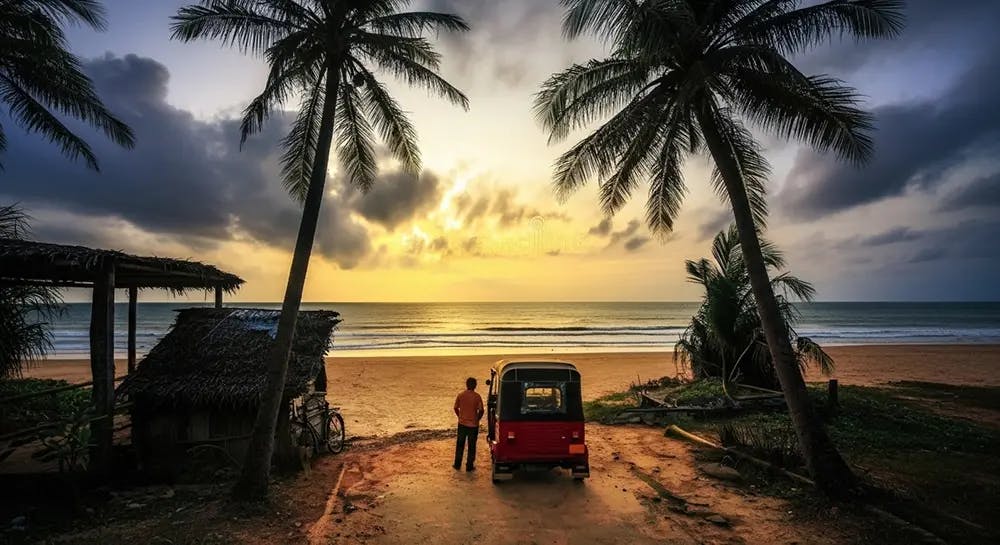
Want to see exactly what this trip looks like in action? Check out the full video log of the journey here. Credit goes to @mikeandashley
Frequently Asked Questions
What is a Sri Lanka tuk-tuk adventure?
A multi-day journey where you drive a three-wheeled vehicle through various regions of Sri Lanka, combining adventure travel with cultural immersion and community challenges. Most trips last 7-10 days.
How much does a tuk-tuk adventure cost?
Organized tours typically cost $3,000-$3,500 USD per person for 10 days, including accommodations, vehicle rental, most meals, and support services. Flights and visas are separate.
For a complete budget breakdown covering accommodation, food, and activities, check our comprehensive Sri Lanka budget travel guide.
Do I need special permits to drive a tuk-tuk?
An International Driving Permit combined with your regular license is recommended, though requirements vary by operator. Most organized tours handle necessary paperwork.
Can tuk-tuks handle monsoon weather?
Technically yes, but it's miserable. Plan trips for April or July to avoid the worst rain. October-November is particularly unpredictable.
What should I bring?
Sunscreen, sunglasses, closed-toe shoes, rain jacket, cash, and minimal luggage. Support vehicles carry your main bags, but pack light.
Is this suitable for families?
Check age requirements. Most operators require drivers be 21+. Some allow children as passengers if old enough to safely hold on during bumpy sections.
How do I book?
Book 6-12 months in advance through established operators like Large Minority. Look for verified reviews and detailed itineraries that specify actual accommodations.
What's the typical tuk-tuk speed?
About 40 km/h (25 mph) on flat roads, slower in mountains. The vehicles simply can't go much faster, which is actually perfect for observation and safety.
Ready to trade comfort for connection? Start planning your Sri Lanka tuk-tuk adventure today. Just remember: when you inevitably get lost, that's not a detour. That's when the real journey begins.
Share this article