
Pekoe Trail Stage 4 : Thawalanthenna to Pundaluoya

 https://images.prismic.io/natouris/aYYBS90YXLCxVgEl_PekoeTrailStage4Thumbnail.webp?auto=format,compress&rect=0,17,1000,525&w=1200&h=630
Pekoe Trail Stage 4 from Thawalanthenna to Pundaluoya spans 15.53 km and marks a profound shift in Sri Lanka's most ambitious trekking route. After three grueling stages of relentless climbs, Stage 4 of the Pekoe Trail offers something different: a walk where history whispers from every valley, where an 84-meter stupa towers over submerged temples, and where locals still greet trekkers with genuine curiosity rather than tourist fatigue. This is the stage that transforms the Pekoe Trail from a physical challenge into a cultural pilgrimage.
What Makes Stage 4 the Pekoe Trail's Best-Kept Secret?
Ask any thru-hiker who's conquered all 300 km of the Pekoe Trail, and they'll tell you: Stage 4 is where everything clicks.
After the vertical punishment of Stage 1, Stage 2, and Stage 3, your legs might be screaming. But Stage 4 offers something better than rest: it offers purpose. This isn't just another tea plantation walk. It's a journey through the hidden sanctuary where ancient kings fled from invaders, where the sacred tooth relic was spirited away during the British occupation, and where 18 temples now sleep beneath reservoir waters.
The trail finally works with you instead of against you. The gradient is forgiving. The scenery rewards every step. And the encounters, from school children practicing English to mulberry trees offering sweet roadside snacks, remind you why you're here in the first place.
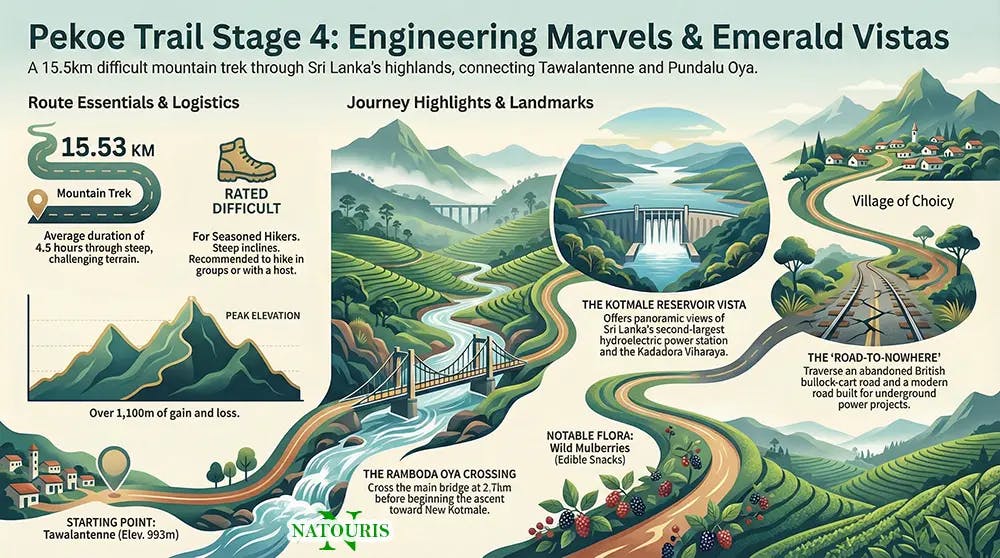
Stage 4 Pekoe Trail Distance, Duration, and Difficulty Level
Let's talk numbers:
Distance: 15.53 km (9.65 miles)
Typical Hiking Time: 5-7 hours
Difficulty: Moderate (significantly easier than Stages 1-3)
Elevation Profile: Gradual ascent to 9 km mark at Choicy village, followed by gentle descent
Metric Stage 4 Details Start Point Thawalanthenna End Point Pundaluoya Highest Point Choicy village (approx. 9 km mark) Trail Type Mix of abandoned British road, village paths, and modern access roads Signage Quality Well-marked with Pekoe Trail signs
Here's what makes the Pekoe Trail Stage 4 difficulty rating refreshingly moderate: after three stages of lung-busting verticality, this route gives you space to breathe. Yes, there's uphill. But it's "tea plantation uphill," not "Himalayan death march uphill." The path follows a 150-year-old British-engineered road designed specifically for bullock carts, which means the gradient was built for animals and heavy loads, not masochistic hikers.
One hiker captured it perfectly: "Today was one of my favorite days on the trail. It was uphill but very, very easy uphill compared to what I have seen in previous days."
The Royal Hideout: Walking Through Sri Lanka's Hidden History
The Kotmale region isn't just scenically stunning. It's historically sacred.
For centuries, this "inaccessible terrain" served as the ultimate insurance policy for Sri Lankan royalty. When threats descended from the coasts, kings retreated into these misty highlands. Prince Dutugamunu, who would become one of Sri Lanka's most celebrated rulers, hid here while dodging his father King Kavantissa's wrath. The valley kept his secret until he was ready to claim his destiny.
But the most profound use of Kotmale as sanctuary came in 1815. As British forces tightened their grip on the island, the sacred tooth relic, Buddhism's most revered artifact in Sri Lanka, was smuggled into these very hills for protection. You're not just hiking through pretty landscapes. You're retracing the escape route of a nation's crown jewel.
The 84-Meter Monument to Progress and Loss
At roughly the halfway point, the trail opens to reveal something staggering: the Kotmale Mahaweli Maha Seya, an 84-meter-high stupa with a 61-meter diameter. It dominates the skyline above the Gamini Dissanayake Reservoir like a spiritual colossus.
This massive structure isn't just impressive architecture. It's a memorial. When the reservoir was completed in 1985, it swallowed 18 temples and shrines. The stupa stands as both tribute and tombstone, marking what progress demanded and what the valley lost.
The visual dialogue between the modern dam and ancient-style stupa creates a moment of reflection you won't find on guidebook itineraries. It's the kind of scene that makes you stop walking and just think.
The Human Encounters That Define Stage 4
Stage 4's magic isn't just geological or historical. It's human.
Unlike more trafficked trekking routes where locals treat tourists like an economic opportunity, the villages along Stage 4 still harbor genuine curiosity. People here haven't developed "tourist fatigue." They're not trying to sell you something. They're trying to know you.
One of the most memorable encounters recorded on this stage involved a group of school children heading to their English class. After a brief roadside chat, the hiker was invited to meet their teacher. What followed was an unplanned afternoon of "oil cakes and tea," conversations about life in the highlands, and kids eagerly practicing their new vocabulary.
These moments don't happen on TripAdvisor's "Top 10" lists. They happen when you're walking slowly enough, and openly enough, to accept unscheduled invitations. That's the real reward of Stage 4.
Engineering Marvels: The Road That Still Works and the Road to Nowhere
As you climb toward Choicy village, you'll notice something peculiar about the path beneath your feet. This isn't a modern trail carved by tourism boards. It's a 150-year-old British-engineered road, and it's still doing its job.
Why the British road is engineering genius:
- Perfect gradient: Designed for bullock carts and horses to navigate steep mountains without excessive strain
- Stonework precision: Hand-fitted masonry that's survived over a century of monsoon rains
- Strategic routing: Connects valley settlements with minimal switchbacks
Now contrast that with the "ghost road" you'll encounter near the underground power station. This wide, smooth asphalt artery was built exclusively to provide construction access for the massive infrastructure project half a kilometer away. Once the station was completed, the road's purpose expired. Now it sits, eerily pristine, serving only as a quiet path for the occasional trekker or farmer.
It's a fascinating study in infrastructure purpose: one road built to last forever, another abandoned the moment its job was done.
At the 7 km mark, watch for the ruins of an old tea factory that might have the best views in all of Sri Lankan tea country. Seriously. Bring your camera.
Pekoe Trail Stage 4 Map, GPS, and Navigation
Stage 4 Pekoe Trail GPS Coordinates:
- Start (Thawalanthenna): 7.2589° N, 80.7428° E
- End (Pundaluoya): 7.0683° N, 80.7767° E
The trail is well-marked with the Pekoe Trail's signature green-and-white signage. That said, download an offline map before you start. Mobile coverage in the Kotmale valleys is spotty at best.
Recommended mapping apps:
- Maps.me (best for offline use)
- Komoot (if you have data coverage)
- Official Pekoe Trail GPX files (available on the Pekoe Trail website)
Signage is reliable, but intersections with village roads can occasionally be confusing. When in doubt, ask locals. They know the trail well and are remarkably helpful.
Best Time to Hike Pekoe Trail Stage 4
The best time to visit Sri Lanka for hiking varies by region, but the central highlands have their own microclimates.
Optimal months: January to April (dry season, clear views)
Shoulder season: May and October (occasional rain, fewer crowds)
Avoid: June to September (heavy southwest monsoon)
Morning starts are ideal. Not only do you avoid afternoon heat, but the early light on tea plantations is absolutely stunning. Mist often clings to valleys until 9 AM, creating that dreamy, ethereal quality you see in professional travel photography.
Temperature-wise, expect 18-25°C (64-77°F) during the day. Mornings can be cool, especially in the valleys. Pack layers.
What to Pack for Stage 4: Essential Gear and Supplies
The must-haves:
- Water: Carry 2-3 liters. There are village shops around the midpoint, but don't rely on them.
- Snacks: Energy bars, nuts, fruit. You'll pass mulberry trees (free snacks!), but bring your own reserves.
- Sun protection: Hat, sunscreen, sunglasses. The open tea plantations offer zero shade.
- Rain gear: Even in dry season, surprise showers happen in the highlands.
- Sturdy footwear: Trail runners or hiking boots. The British road sections are rocky.
- First aid kit: Basic supplies, blister treatment, pain relievers.
- Mobile battery pack: For GPS and photography.
Optional but recommended:
- Trekking poles (helpful on steeper sections)
- Small daypack (25-30L is perfect)
- Swimsuit (some guesthouses have pools or hot showers)
Permits, Fees, and Official Resources
Good news: there are no permits or tickets required for Stage 4. The Pekoe Trail is a free-access route. However, some guesthouses and tea estates along the way may charge small fees for facilities or tours.
Official Resources:
- Pekoe Trail official website: https://thepekoetrail.org
- Contact: info@thepekoetrailsrilanka.com
- Emergency: Sri Lanka Tourist Police 1912
Always check the official site before you hike. Trail conditions, diversions, and route updates are posted regularly.
Is Stage 4 Suitable for Beginners and Families?
Short answer: Yes, with caveats.
If you're reasonably fit and comfortable with 6-7 hours of walking, Stage 4 is manageable. It's significantly easier than the first three stages, making it a good "sampler" for those who want to experience the Pekoe Trail without committing to the full route.
For families: Children 10+ with hiking experience will likely enjoy it. Younger kids might struggle with the distance. The trail itself is safe, but there are no emergency facilities along the route.
For beginners: If this is your first multi-hour hike, Stage 4 is forgiving. Just ensure you've done some preparatory walks beforehand. Arriving fresh without training will make those 15 km feel much longer.
Do You Need a Guide for Stage 4?
Technically? No. The trail is well-marked and straightforward.
Practically? A guide adds value.
Local guides don't just prevent you from getting lost (which is unlikely). They unlock the cultural layers you'd otherwise walk past without noticing. That abandoned tea factory? Your guide knows who owned it. That village path? They'll introduce you to the English teacher who might invite you for tea.
If you're hiking solo or want deeper cultural immersion, hiring a local guide from Thawalanthenna or Pundaluoya is worth the cost (typically $30-50 USD for the day).
How to Access the Stage 4 Trailhead
Getting to Thawalanthenna (start point):
- From Kandy: Take a bus toward Gampola, then transfer to a Nawalapitiya-bound bus. Get off at Thawalanthenna junction (approx. 2.5 hours total).
- By private vehicle: Hire a tuk-tuk or taxi from Kandy (1.5 hours, ~$25-35 USD).
- From Stage 3: If you're thru-hiking, you'll arrive on foot.
Getting to Pundaluoya (end point):
Pundaluoya is a railway town on the famous Kandy-Ella line. It's incredibly easy to catch a train from here to Nuwara Eliya, Ella, or back to Kandy. Sri Lanka's train journeys through the hill country are legendary, and Pundaluoya sits right on one of the most scenic sections.
Guesthouses and Lodging:
Both Thawalanthenna and Pundaluoya have basic guesthouses. Book ahead during peak season (January-March).
Safety Considerations for Stage 4
Weather: Highland weather changes fast. Morning sunshine can become afternoon storms. Always carry rain gear.
Wildlife: Minimal concerns. You might see monkeys, birds, and occasionally wild boar. None are typically aggressive, but don't approach or feed them.
Terrain: The trail is generally safe, but watch your footing on the British road sections where stones can be loose or slippery after rain.
Hydration: Heat exhaustion is real. Drink water regularly, not just when you're thirsty.
Mobile coverage: Patchy at best. Download offline maps and inform someone of your hiking plans before you start.
How Stage 4 Connects to the Broader Pekoe Trail Experience
The Pekoe Trail stages list consists of 22 stages covering roughly 300 km through Sri Lanka's tea country. Stage 4 sits in a unique position as the "cultural pivot point."
- Stages 1-3: Physical gauntlet. Vertical, demanding, lung-testing climbs.
- Stage 4: Cultural immersion. Easier terrain, richer history, deeper human connections.
- Stages 5+: The trail becomes more remote, wild, and adventurous.
If you're considering sampling just one or two stages rather than the full route, Stage 4 offers the most complete experience: manageable distance, stunning scenery, historical depth, and genuine local encounters.
For those planning the full thru-hike, Stage 4 is where your body finally forgives you and your mind starts to wander beyond survival mode into genuine exploration.
The Bittersweet Descent into Pundaluoya
As you descend the final kilometers toward Pundaluoya, something shifts. The physical challenge that defined the first three stages fades into the background. What remains are the stories: the kings who hid in these valleys, the temples sleeping beneath reservoir waters, the English teacher who shared oil cakes and conversation, the ancient road still doing its job after 150 years.
Stage 4 is where the Pekoe Trail stops being just a hike and becomes something more. It's an invitation to slow down, to look beyond the next ridge, to accept tea from strangers and learn the names of villages that aren't on any tourist map.
This is the stage that changes you. Not with vertical gain or physical exhaustion, but with the quiet realization that the best journeys aren't measured in kilometers conquered, but in moments collected.
Ready to experience the Pekoe Trail for yourself? Start planning your Sri Lanka trekking adventure with our complete Pekoe Trail guide, explore what to see in Sri Lanka, or discover hidden gems off the beaten path. The trail is waiting.
Share this article