
Pekoe Trail Stage 3 Guide: Sri Lanka's Toughest Tea Trek

 https://images.prismic.io/natouris/aYX67N0YXLCxVgAe_PekoeTrailStage3Thumbnail.webp?auto=format,compress&rect=0,17,1000,525&w=1200&h=630
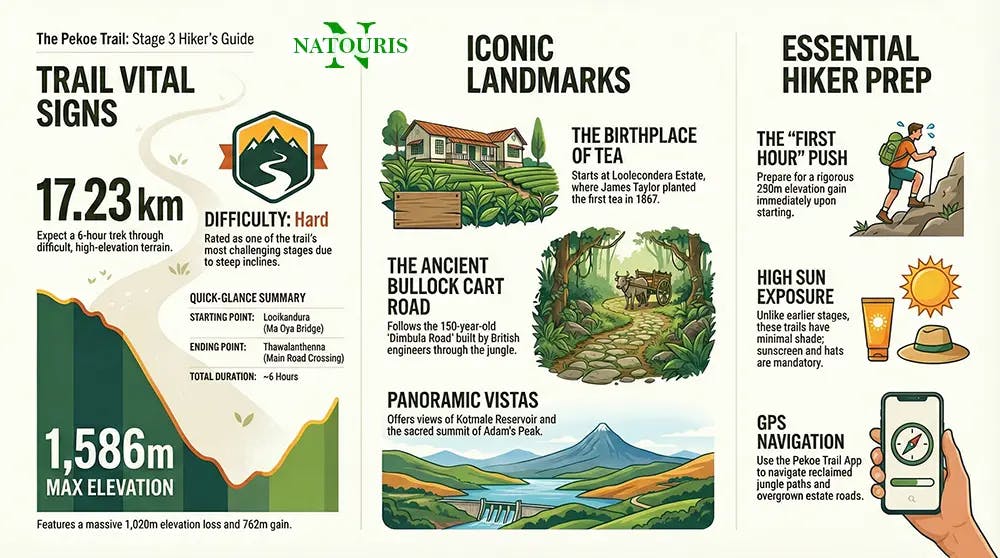
If you've trekked Pekoe Trail Stage 1 and Stage 2, you already know the drill: rolling tea estates, historical weight, and enough elevation gain to make your calves scream. But here's the plot twist nobody tells you about Pekoe Trail Stage 3: this 17-18 km stretch from Loolecondera to Thawalantenna is where the trail stops being polite and starts getting real.
This is the section where signage becomes more of a "suggestion" than a guarantee, where the Pekoe Trail Sri Lanka reveals its raw, unfiltered personality, and where most casual hikers tap out. If you're reading this, you're not most hikers. You're the kind of person who wants to experience the Central Highlands trekking route that even seasoned adventure travelers underestimate.
Why Stage 3 Is the Trail's Best-Kept Secret (And Its Biggest Challenge)
Let's address the elephant in the room: Pekoe Trail Stage 3 has a reputation problem. While Stage 2 gets all the glory for its James Taylor heritage and Stage 1 charms first-timers with its Hanthana accessibility, Stage 3 exists in a weird limbo between "under development" and "navigable if you know what you're doing."
Here's what makes this stage simultaneously intimidating and irresistible.
The Distance Reality Check
The Stage 3 distance clocks in at approximately 17-18 km, making it the longest single-day push on the Pekoe Trail stages so far. But raw distance tells only half the story. The Pekoe Trail Stage 3 elevation profile is a cardiovascular rollercoaster, with cumulative gains and losses that compound the physical toll.
For context, this is roughly 3-4 km longer than Stage 2, but the terrain shifts dramatically. Where Stage 2 offered manicured estate paths with occasional jungle interruptions, Stage 3 leans heavily into the "nature is reclaiming this route" aesthetic. Expect overgrown sections, fallen trees, and the distinct possibility that the path you're following was last cleared by someone's uncle in 2023.
Navigation: A Choose-Your-Own-Adventure Nightmare
The Pekoe Trail waymarks and signage situation on Stage 3 is... optimistic. Yellow and red concrete posts exist, but their reliability varies wildly depending on recent maintenance efforts. Some hikers report finding markers every 200 meters; others describe 2 km gaps where you're essentially bushwhacking with a prayer.
This is where your backup plan becomes your primary plan. The Pekoe Trail GPS files are non-negotiable for this stage. Download offline maps through the official Pekoe Trail app before you lose cell service (which you will, repeatedly). Pro tip from the tea estate hiking Sri Lanka veterans: screenshot your route at multiple zoom levels. When your GPS glitches mid-forest, those static images might be the difference between staying on track and accidentally summiting a completely different mountain.
[INSERT IMAGE: Close-up of a weathered yellow trail marker post surrounded by overgrown vegetation]
The Terrain: What You're Actually Walking Through
Starting Strong at Loolecondera
The Stage 3 trailhead Loolecondera picks up where Stage 2 deposits you: at the historic heart of Ceylon tea's origin story. The trailhead Ma Oya bridge serves as your ceremonial starting gate, and for the first 3-4 km, you'll enjoy the false sense of security that comes with well-maintained estate roads.
This opening section is deceptively pleasant. The gradual ascent through active tea plantations offers textbook photo opportunities, and you'll likely encounter estate workers who've seen enough confused foreigners with backpacks to know exactly where you're headed. Don't be surprised if someone points you toward a shortcut; accept the local knowledge gracefully.
The Middle Section: Where Things Get Spicy
Around the 8-10 km mark, the Pekoe Trail Stage 3 terrain shifts personality. The manicured estates give way to transitional forest zones where the canopy thickens and the path narrows considerably. This is prime leech territory, so if you thought Stage 2's "leech action" was intense, buckle up.
The Pekoe Trail difficulty rating jumps significantly in this section. You're navigating:
- Stream crossings with questionable footing
- Steep descents on rain-slicked clay paths
- Sections where the "trail" is just a narrow corridor through chest-high vegetation
One trekker's GPS log described this middle segment as "70% hiking, 30% interpretive dance to avoid face-plants." That tracks.
The Final Push to Thawalantenna
The Stage 3 Loolecondera to Thawalantenna route concludes with a series of undulating hills that test whatever leg strength you have remaining. The terrain opens up slightly as you approach Thawalantenna, offering panoramic views of the surrounding valleys if the weather cooperates (spoiler: it often doesn't).
The endpoint itself is anticlimactic by design. Thawalantenna is a functional village, not a tourist destination. You'll find basic amenities, maybe a small shop, and the profound satisfaction of having completed what many consider the Pekoe Trail's most technically demanding day hike.
Logistics That Will Save Your Trek
Timing: When to Tackle Stage 3
The best time for Pekoe Trail Stage 3 mirrors the broader Sri Lanka long-distance hike season, but with extra emphasis on avoiding the monsoon. January to March offers the most reliable weather window, with clearer skies and marginally drier trails.
That said, "drier" is relative in the Central Highlands. Even during peak season, expect afternoon cloud cover and possible drizzle. The Pekoe Trail Stage 3 accessibility improves dramatically when the ground isn't actively turning into a mud wrestling arena.
Month Weather Conditions Trail Difficulty Recommendation Jan-Mar Dry, Clear Moderate-Difficult Ideal Apr-May Variable, Pre-Monsoon Difficult Possible Jun-Sep Monsoon, Wet Very Difficult Avoid Oct-Dec Post-Monsoon, Improving Difficult Manageable
For more context on navigating Sri Lanka's climate zones, check out our best time to visit Sri Lanka monthly guide.
How Long Does This Actually Take?
The how long Stage 3 takes depends entirely on your fitness level and navigational confidence. Official estimates suggest 6-8 hours of continuous hiking, but real-world reports range from 5 hours (ultralight speed demons) to 10+ hours (cautious first-timers dealing with route-finding challenges).
Budget for the higher end of that estimate. This isn't a stage where you want to be racing sunset.
Gear That Matters
Your Pekoe Trail Stage 3 packing list should prioritize navigation and weather protection over comfort luxuries:
Critical Items:
- GPS device with downloaded offline maps
- Physical map as backup (seriously)
- Leech socks (double layer if you're paranoid)
- Waterproof jacket and pack cover
- Headlamp with fresh batteries
- Emergency whistle
- First aid kit with blister treatment
Highly Recommended:
- Trekking poles for stability on descents
- Quick-dry clothing layers
- Water purification tablets or filter
- High-calorie snacks (trail mix, energy bars)
- Local SIM card for emergencies (coverage is spotty but exists)
For a comprehensive breakdown of trekking essentials, our must-have travel gear for Southeast Asia guide covers the overlapping fundamentals.
Safety Considerations That Aren't Optional
Weather: The Central Highlands' Mood Swings
Mountain weather in this region is notoriously bipolar. Morning sunshine can transform into dense fog within 20 minutes, and rain squalls appear with minimal warning. The Pekoe Trail hike safety tips veteran hikers swear by: start early (6-7 AM), monitor cloud formations obsessively, and carry more layers than you think necessary.
If conditions deteriorate mid-trek, your options are limited. There are minimal bailout points once you're committed to the middle section. This is why checking the Pekoe Trail opening status before you depart isn't paranoia it's due diligence. The official Pekoe Trail website updates closure information when sections become legitimately hazardous.
Wildlife and Other Trail Companions
Leeches are your primary non-human encounter on Stage 3. These enthusiastic little bloodsuckers are most active in humid forest sections and after rain. The good news: they're harmless beyond being creepy. The bad news: you will find them attached to your legs at some point.
Less common but worth noting: the Central Highlands host various snake species, most of which prefer avoiding humans as much as you prefer avoiding them. Watch your footing in tall grass and around rock piles. Monkeys occasionally appear near the estate boundaries; they're habituated to humans but not particularly friendly.
For broader context on safety while exploring Sri Lanka's wilder regions, our Sri Lanka safe for tourists 2026 complete guide addresses common concerns.
The Solo Hiker Question
Can Stage 3 be completed solo? Technically, yes. Should it? That's more complicated.
The Pekoe Trail stage 3 difficulty rating combined with unreliable signage makes solo trekking genuinely risky for anyone without solid backcountry navigation experience. If you're determined to go alone:
- Inform someone of your exact route and expected return time
- Carry a personal locator beacon or satellite communicator
- Have a concrete Plan B if you miss a critical turn
- Acknowledge that mobile phone coverage is inconsistent at best
The more prudent option: hire a local guide or join a small group. Several guesthouses in the Loolecondera area can connect you with experienced guides who know the current trail conditions and alternate routes.
Permits, Access, and Bureaucratic Realities
Do You Need Special Permission?
The short answer: Stage 3 permits or tickets are not currently required. The Pekoe Trail crosses private tea estate land, but the route itself is open to respectful hikers. However, this status could change as the trail formalizes, so verify current requirements before traveling.
What you do need: permission to camp if you're planning an overnight approach. Wild camping on estate property is technically prohibited, though enforcement varies. Respect private property boundaries and ask permission if you need to cross through active plantation areas.
Trailhead Access Points
The Stage 3 trailhead at Loolecondera is reachable by:
- Private vehicle (most flexible option)
- Local bus from Kandy (budget-friendly but time-consuming)
- Arranged transport through guesthouses
The Ma Oya bridge is your landmark. If you're arriving from Stage 2, you'll already be familiar with the area. If you're starting fresh at Stage 3, coordinate with your accommodation in advance; GPS coordinates don't always translate well to Sri Lankan addresses.
The Thawalantenna endpoint has less developed transport options. Arrange a pickup in advance or budget for a longer wait to flag down a passing bus or three-wheeler.
Guided vs. Independent: The Honest Calculus
When Hiring a Guide Makes Sense
The guided options for Stage 3 range from full-service outfitters to local estate workers who moonlight as trail guides. Benefits of going guided:
- Current knowledge of trail conditions and recent changes
- Cultural context you'd otherwise miss
- Safety net if navigation or weather becomes problematic
- Support with logistics and transport coordination
Expect to pay $30-60 USD for a competent day guide, more for multi-day packages with accommodation and meals included. For recommendations on booking reliable guides, our Pekoe Trail Sri Lanka complete hiking guide breaks down reputable operators.
The Independent Hiker's Reality Check
Going solo or with friends requires absolute honesty about your capabilities. Stage 3 isn't the place to discover you're bad at reading topographic maps or that your fitness level doesn't match your ambition.
Prerequisites for independent hiking:
- Proven backcountry navigation skills
- Physical conditioning for 8+ hour days with elevation
- Experience reading trail conditions and making go/no-go decisions
- Comfort with self-rescue scenarios
If you're checking most of those boxes, the independence is profoundly rewarding. You move at your own pace, linger where you want, and earn the full satisfaction of self-sufficient adventure.
What GPS Can't Tell You: The Intangible Experience
The Cultural Thread
Stage 3 continues the ethnic and religious tapestry that defines the tea estate hiking Sri Lanka experience. You're walking through Tamil estate worker communities whose families have maintained these slopes for generations. The shrines, the language, the chai breaks at tiny roadside stalls these aren't tourism performances. This is daily life that happens to intersect with your trek.
Approach these interactions with genuine curiosity rather than transactional tourism. A few Tamil phrases go a surprisingly long way, and showing interest in the tea cultivation process often leads to impromptu mini-tours of estate facilities.
The Solitude Factor
Unlike the more trafficked sections of popular Sri Lankan trekking routes (looking at you, Adam's Peak), Stage 3 offers legitimate solitude. You might encounter a handful of other hikers, or you might spend eight hours seeing nobody except the occasional estate supervisor on a motorbike.
For travelers saturated with crowded hostels and selfie-stick battlegrounds, this isolation is therapeutic. The silence broken only by bird calls and rustling tea leaves has a meditative quality that's increasingly rare in modern travel.
The Weather Drama
Mountain mist isn't just a visual element it fundamentally alters the trek's character. When fog rolls in and visibility drops to 20 meters, the trail becomes an exercise in present-moment focus. You're not admiring distant vistas; you're navigating the next 10 steps, trusting your compass bearing, moving through a landscape that feels both intimate and infinite.
Some hikers find this claustrophobic. Others find it transcendent. Know which camp you're in before committing to Stage 3 in questionable weather.
Frequently Asked Questions
What is Pekoe Trail Stage 3? Stage 3 is the third section of Sri Lanka's 300 km Pekoe Trail, running approximately 17-18 km from Loolecondera (the birthplace of Ceylon tea) to Thawalantenna through varied terrain including tea estates, transitional forests, and highland paths.
Where does Stage 3 of Pekoe Trail start and end? It starts at the Ma Oya bridge near Loolecondera Estate and ends at Thawalantenna village. The trailhead is accessible from Kandy via local transport or arranged transfers.
How long does Stage 3 take to complete? Expect 6-10 hours depending on fitness level, weather conditions, and navigation efficiency. Most hikers average 7-8 hours including short breaks.
What is the difficulty level of Stage 3? Officially rated Difficult due to distance, elevation changes, inconsistent trail markings, and sections prone to overgrowth. Not recommended for novice hikers or those uncomfortable with backcountry navigation.
What sights or landscapes can I expect on Stage 3? You'll traverse active tea plantations, transitional forest zones, stream crossings, and panoramic highland viewpoints (weather permitting). The route offers a mix of cultivated estates and wilder, less-maintained natural areas.
Is Stage 3 signposted or well-marked? Partially. Yellow and red concrete markers exist but vary in consistency. Recent reports indicate gaps in signage, particularly in forested middle sections. GPS navigation is strongly recommended as backup.
Do I need permits or tickets for Stage 3? Currently no formal permits are required, though this may change as the trail develops. Respect private estate boundaries and obtain permission if planning overnight camping.
What is the best time of year to hike Stage 3? January through March offers the most stable weather with clearer skies and drier trails. Avoid the monsoon season (June-September) when paths become hazardous.
What are the access points or trailheads for Stage 3? Primary access is the Ma Oya bridge at Loolecondera (start) and Thawalantenna village (end). Both are reachable via local bus from Kandy or arranged private transport.
What safety considerations should I know for Stage 3? Rapid weather changes, slippery terrain during/after rain, leeches in forested sections, limited bailout points mid-route, and spotty mobile coverage. Carry emergency supplies and inform someone of your plans.
Can Stage 3 be completed as a day hike or does it require overnight stays? It's designed as a challenging day hike but requires an early start. Some hikers split it across two days with camping (requires permission) or arrange homestay options in villages along the route.
Are there guided options for Stage 3? Yes, local guides can be hired through guesthouses in Loolecondera or through trekking agencies specializing in the Pekoe Trail. Expect to pay $30-60 USD for day guiding services.
What equipment or gear is recommended for Stage 3? GPS with offline maps, leech socks, waterproof layers, trekking poles, headlamp, first aid kit, water purification, high-energy snacks, and sturdy hiking boots with good tread.
How do I navigate Stage 3 if GPS/map apps fail? Carry a physical topographic map and compass as backup. Screenshot your route at multiple zoom levels before losing signal. Follow yellow/red trail markers where present and don't hesitate to backtrack if uncertain.
Finally: Should You Actually Do This?
Stage 3 isn't for everyone, and that's precisely what makes it valuable.
If you want Instagram-friendly tea tourism with guaranteed comfort and clear signage, stick to the estate tours near Nuwara Eliya. If you want to earn your understanding of the Central Highlands trekking landscape through sweat, problem-solving, and occasional discomfort, Stage 3 delivers in spades.
This section rewards preparation, punishes overconfidence, and offers the kind of authentic challenge that's increasingly commodified out of modern adventure travel. You're not following a manicured path with safety rails and mile markers. You're navigating a working landscape that tolerates hikers but wasn't designed for them.
For travelers who've already conquered Pekoe Trail Stage 1 and Stage 2, Stage 3 is the natural escalation. It's where the trail stops holding your hand and starts demanding competence.
Ready to commit? Download those GPS files, test your gear, and embrace the fact that your comfort zone ends at the Ma Oya bridge. What begins on the other side is the kind of trek that reminds you why you started traveling in the first place.
Share this article