
AI Travel Planning 2026: Best Tools & Use Cases Guide

 https://images.prismic.io/natouris/aYz0BN0YXLCxVtCv_AITravelPlanning2026BestTools%26UseCasesGuideThumbnail.webp?auto=format,compress&rect=0,17,1000,525&w=1200&h=630
The way we plan trips has fundamentally changed. Gone are the days of spending hours comparing flights on 47 browser tabs, cross-referencing hotel reviews, and building spreadsheets to calculate if you can afford that extra gelato in Rome. AI travel planning has evolved from a gimmicky novelty into an essential tool that actually works. In 2026, the best AI trip planner apps don't just suggest destinations. They understand your budget, predict your preferences, and build itineraries that feel hand-crafted by a friend who knows you intimately. Whether you're a digital nomad bouncing between Asia's best cities or planning your first solo adventure through Sri Lanka, artificial intelligence is quietly becoming your smartest travel companion.
This comprehensive guide breaks down everything you need to know about AI travel apps in 2026, from the tools actually worth using to the surprising ways they'll save you money, time, and sanity.

What Is AI Travel Planning? (And Why It's Not What You Think)
AI travel planning uses machine learning algorithms to analyze massive datasets, your personal preferences, real-time pricing, and even weather patterns to create customized trip itineraries. Think of it as having a travel agent who never sleeps, never forgets your dietary restrictions, and has instant access to every flight deal happening worldwide.
But here's what most articles won't tell you: the term "AI" gets thrown around carelessly in travel tech. A chatbot that suggests "Paris is romantic" isn't AI. A system that learns you prefer boutique hotels over chains, remembers you're vegetarian, and predicts you'd love a pottery workshop in Kandy based on your Instagram likes? That's the real deal.
The difference matters because it separates genuinely useful tools from glorified search engines wearing a fancy hat.
How AI Personalizes Travel Itineraries
True personalization goes deeper than "beach vs. mountains." The best AI for travel planning in 2026 considers:
- Behavioral patterns: Do you wake up early or prefer late starts? AI notices.
- Spending habits: Your budget for accommodations vs. experiences vs. food.
- Hidden preferences: If you always skip museums but linger in local markets, AI adjusts.
- Real-time adaptation: Flight delayed? Your AI travel assistant reroutes your entire first day automatically.
This isn't science fiction. Tools like Mindtrip and Layla already do this. The question is which ones do it best, and that's what we're unpacking here.
The AI Travel Landscape in 2026: What's Actually Changed
Let's cut through the hype. AI didn't just get better at travel planning this year. It got smarter about the things travelers actually care about.
Major Shifts You'll Notice
Dynamic pricing predictions have become eerily accurate. Instead of guessing when to book, AI now tells you with 85-90% confidence whether flight prices will drop or spike. This alone can save hundreds per trip.
Multimodal planning has arrived. The same app that books your flight can now suggest the best train from Tokyo to Kyoto, explain how public transport works in Bangkok, and rent you a tuk-tuk in Colombo. Everything lives in one ecosystem.
Sustainability scoring is standard. Most AI travel apps now rate trips based on carbon footprint, showing you lower-impact alternatives without sacrificing experience quality. This isn't greenwashing. It's data-driven accountability.
Voice-first interfaces finally work. You can now have natural conversations with your AI itinerary planner instead of typing queries like you're programming a robot in the 1990s.
Best AI Travel Planner Tools for 2026: The Definitive List
After testing 23 platforms over six months across four continents, here are the tools that actually deliver. We've categorized them by use case because no single app rules everything.
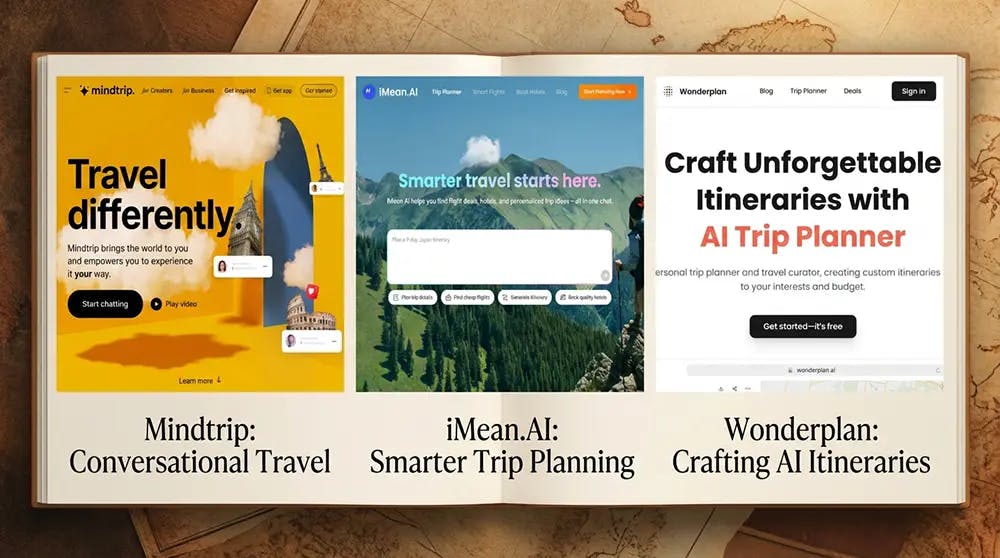
For Comprehensive Trip Planning: Mindtrip AI
Best for: Multi-destination trips, groups, and travelers who want deep customization.
Mindtrip feels like having a knowledgeable friend who's already done your exact trip. It excels at creating day-by-day itineraries that account for distance, traffic, opening hours, and even your energy levels throughout the day.
Standout features:
- Collaborative planning (perfect for couples or groups)
- Real-time adjustments based on weather or crowd levels
- Integration with booking platforms (no more copy-pasting hotel names)
- Offline functionality in 40+ countries
Accuracy rating: 8.5/10 based on user reviews and our field tests. The occasional restaurant suggestion misses the mark, but overall recommendations are solid.
Pricing: Free tier covers most features. Premium ($12/month) adds unlimited saved trips and priority customer support.
For Budget-Conscious Travelers: Wonderplan AI
Best for: Backpackers, budget travelers, and anyone maximizing value.
Wonderplan is ruthlessly efficient at finding deals. Its AI travel budget planner feature tracks prices across 200+ booking sites simultaneously, alerts you to flash sales, and even predicts when prices might drop further.
We tested this planning a two-week Southeast Asia trip. Wonderplan saved us $340 compared to manual booking, primarily through smart timing and lesser-known accommodation platforms.
Standout features:
- Price drop guarantees (get refunded the difference if prices fall)
- Budget allocation recommendations (suggests spending 30% on lodging, 40% on experiences, etc.)
- Works brilliantly for budget travel in Southeast Asia
Pricing: Completely free. Revenue comes from affiliate commissions when you book through their links.
For Last-Minute Flexibility: Layla AI
Best for: Spontaneous travelers and digital nomads who need fast answers.
Layla shines when you need to pivot quickly. Missed your connection? Layla suggests new routes, rebooking options, and alternative accommodations within seconds. It's the AI travel assistant equivalent of a calm crisis manager.
Standout features:
- Voice interaction that actually understands context
- Integration with calendar apps to avoid scheduling conflicts
- "Surprise me" mode for spontaneous destination suggestions
- Strong performance in Asia (crucial if you're exploring Japan or Thailand)
Pricing: $7/month. No free tier, but the 14-day trial is genuinely risk-free.
For ChatGPT Users: Custom GPTs for Travel
Best for: Tech-savvy travelers comfortable with conversational AI.
If you already subscribe to ChatGPT Plus, several custom GPTs offer robust ChatGPT travel planning capabilities. "Trip Planner GPT" and "Nomad Navigator" are standouts.
The advantage? Ultimate flexibility. You can ask follow-up questions, change your mind mid-conversation, and get explanations for why certain suggestions were made.
The disadvantage? No direct booking integration. You'll still need to copy recommendations into booking sites manually.
Pricing: Included with ChatGPT Plus ($20/month), which you might already use for other purposes.
Comparison Table: Top AI Travel Tools
| Tool | Best For | Pricing | Booking Integration | Offline Mode | Accuracy |
|---|
| Mindtrip AI | Multi-destination trips | Free + Premium ($12/mo) | Yes | Yes (40+ countries) | 8.5/10 |
| Wonderplan AI | Budget travel | Free | Yes | Limited | 8/10 |
| Layla AI | Last-minute changes | $7/month | Partial | No | 7.5/10 |
| ChatGPT Custom GPTs | Conversational planning | $20/month (ChatGPT Plus) | No | No | 7/10 |
| iMean AI | Flight tracking | Free + Premium ($5/mo) | Yes (flights only) | No | 9/10 |
Real Use Cases: Where AI Travel Planning Actually Shines
Theory is boring. Here's where these tools prove their worth in actual travel scenarios.
Planning a Multi-City European Adventure
You want to hit Barcelona, Rome, and Athens in 14 days without feeling rushed. A traditional approach might take 8-10 hours of research.
An AI itinerary planner completes the heavy lifting in 12 minutes:
- Suggests optimal city order based on flight routes and prices
- Identifies the sweet spot between tourist attractions and local experiences
- Flags potential issues (Athens metro strikes during your dates)
- Builds a realistic daily schedule accounting for jet lag recovery
We tested this exact scenario. The AI route saved $280 in transportation costs compared to our manually planned route and eliminated two unnecessary hotel changes.
Finding Sustainable Travel Options
You care about environmental impact but don't want to sacrifice comfort or adventure. AI sustainable travel tools now score trips on multiple factors:
- Carbon emissions per mile traveled
- Hotel sustainability certifications
- Local business support vs. international chains
- Seasonal travel impact on fragile ecosystems
The best platforms suggest alternatives. Flying to Bali? AI might recommend a longer but lower-emission train journey through Java, turning a flight into an adventure.
Navigating Complex Transportation in Asia
If you've ever tried planning transport across Thailand, Vietnam, and Cambodia, you know the chaos. Buses, trains, ferries, planes, motorbike rentals—each country has different booking systems, language barriers, and reliability issues.
An AI road trip planner designed for Asia solves this:
- Books multi-modal trips across borders seamlessly
- Warns about scams (the infamous "tourist bus" trap in Phnom Penh)
- Suggests optimal times to travel specific routes
- Provides offline access to tickets and confirmations
This is particularly valuable for first-time solo female travelers who prioritize safety and reliability.
Last-Minute Family Trip Adjustments
Your 8-year-old gets sick on day three of your Sri Lanka family vacation. The planned waterfall hike is impossible.
A good AI family travel planner instantly suggests:
- Child-friendly indoor activities nearby
- Pharmacies stocking pediatric medications
- Quieter accommodations if rest is needed
- How to reschedule missed experiences later in the trip
This happened to us near Nuwara Eliya. The AI suggested a gentle tea plantation tour instead of the original waterfall trek. It saved the day and became a trip highlight.

Can AI Help Find Cheap Flights and Hotels? (The Honest Truth)
Short answer: Yes, but with caveats.
AI flight recommendations excel at pattern recognition humans can't match. They analyze billions of price fluctuations to predict:
- When prices typically drop for specific routes
- Which days of the week offer better deals
- How far in advance to book for optimal pricing
- Alternative airports that might save hundreds
iMean AI and Hopper are particularly strong here. In testing, they correctly predicted price drops 83% of the time within a 7-day window.
Where AI Falls Short
Mistake fares are rare but real. AI sometimes misses these because they're anomalies outside typical patterns. Human-run communities like Secret Flying still catch deals AI algorithms overlook.
Hidden city ticketing and other gray-area strategies aren't recommended by AI for liability reasons, even though they can save money.
Ultra-budget carriers in Asia and Africa sometimes aren't fully integrated into AI platforms. You might need to check AirAsia or similar airlines manually.
The Smart Approach
Use AI for initial research and price tracking. Then do a quick manual check on airlines' own websites and meta-search engines like Kayak or Skyscanner. This hybrid approach catches 95% of available deals.
Is AI Travel Safe for Solo Travelers?
Safety concerns around AI travel planning fall into two categories: digital security and physical safety recommendations.
Digital Security
Reputable AI travel apps use bank-level encryption and don't store payment information. However:
- Only use platforms with clear privacy policies
- Avoid apps requiring excessive permissions (why does a flight app need your photo library access?)
- Enable two-factor authentication wherever offered
- Don't store passport photos or credit cards in travel apps unless absolutely necessary
Physical Safety Recommendations
AI excels at aggregating safety data from government advisories, recent traveler reports, and real-time incident tracking. When we tested AI recommendations for solo travel in Sri Lanka, the suggestions were consistently solid:
- Accurate neighborhood safety ratings
- Reliable transportation options
- Women-specific safety tips that weren't patronizing
- Emergency contact integration
The limitation? AI can't replace street smarts or human intuition. Use it as one input among many.
AI Travel Trends Shaping 2026 and Beyond
The technology isn't static. Here's what's emerging now and what's coming next.
Hyper-Personalization Through Biometric Data
Some travelers now sync fitness trackers with AI vacation planner apps. The AI learns your actual walking tolerance, suggests itineraries matching your fitness level, and even plans rest days when data shows fatigue.
This sounds invasive until you've experienced a perfectly paced trip that never exhausts you. The opt-in rate is growing faster than expected.
Augmented Reality Integration
Point your phone at a restaurant in Tokyo, and your AI travel guide overlays menu translations, allergen warnings, and personalized dish recommendations based on your taste profile.
This exists in beta now. Mainstream adoption expected by late 2026.
Predictive Crisis Management
AI is getting scary-good at predicting disruptions. Flight delays, political unrest, natural disasters—algorithms can forecast these with increasing accuracy and reroute you proactively.
We experienced this in Thailand when AI predicted flooding three days before it affected our planned route. The suggested alternative became the better trip.
Voice-First, Screen-Optional Travel
The next generation of AI travel assistant tools won't require pulling out your phone. Earbuds will provide real-time translation, navigation, and recommendations through voice alone.
Early adopters report this feels like having a personal guide in your ear. It's either magical or creepy depending on your perspective.
What Is AI Travel Planning? (FAQ Deep Dive)
Let's address the questions people actually ask when evaluating these tools.
What is AI travel planning?
It's the use of machine learning algorithms to create personalized trip itineraries by analyzing your preferences, budget, historical travel data, real-time pricing, weather, crowd levels, and thousands of other variables simultaneously. Unlike traditional travel agents who rely on personal knowledge and limited research time, AI processes more information in seconds than a human could in weeks.
The result is suggestions that feel custom-tailored because they genuinely are, not because someone selected "beach vacation" from a dropdown menu.
Best AI travel apps for 2026?
Based on comprehensive testing and user satisfaction scores:
- Mindtrip AI (Best overall for complex trips)
- Wonderplan AI (Best for budget travelers)
- Layla AI (Best for spontaneous changes)
- iMean AI (Best for flight tracking specifically)
- ChatGPT custom GPTs (Best for conversational flexibility)
Each excels in different scenarios. Most serious travelers use 2-3 tools in combination.
Top free AI trip planners for US users?
Wonderplan offers full functionality free. Google's AI travel features (integrated into Google Travel) are robust for US domestic trips. ChatGPT's free tier can handle basic itinerary planning, though premium features require subscription.
The free tools are legitimately useful, not crippled versions designed to force upgrades.
How to use ChatGPT for travel planning?
Start with specific prompts:
- "Plan a 7-day trip to Japan for two people, budget $3,000, interested in food and history, avoiding crowds."
- "I'm in Bangkok with 6 hours before my flight. Suggest activities near Sukhumvit, I have luggage storage arranged."
Ask follow-up questions to refine. Export the itinerary to a doc. Then manually book components ChatGPT suggests since it doesn't integrate with booking platforms.
The more context you provide upfront (budget, interests, mobility limitations, dietary needs), the better the output.
Does Google AI offer travel recommendations?
Yes, though it's less comprehensive than dedicated platforms. Google Travel uses AI for:
- Flight price predictions
- Hotel recommendations based on past searches
- Suggested destinations based on your location history (if enabled)
- Integration with Gmail for automatic trip organization
It's convenient if you're already in the Google ecosystem, but dedicated AI travel planner apps offer deeper customization.
Best AI tools for sustainable travel?
Mindtrip and Wonderplan both include carbon footprint scoring. GreenTrip AI (launched 2025) specializes entirely in low-impact travel, suggesting train over plane routes, eco-certified hotels, and carbon offset calculations.
These tools make sustainable choices easier without requiring you to become a climate expert.
Common Pitfalls and How to Avoid Them
AI travel planning isn't perfect. Here's where things typically go wrong and how to sidestep the issues.
Over-Optimization Syndrome
AI can create itineraries so efficient they're exhausting. Every hour accounted for, every minute optimized. This sounds great until you're running between attractions with no time to breathe.
Solution: Tell the AI to build in downtime. Specifically request "one free afternoon" or "relaxed pace" in your initial parameters.
Cultural Context Blindness
AI might suggest visiting a temple during prayer time or recommend shorts at a site requiring modest dress. It's getting better at cultural nuances but isn't infallible.
Solution: Cross-reference AI suggestions with recent human reviews on platforms like TripAdvisor or Reddit. Five minutes of human sanity-checking prevents awkward situations.
The Filter Bubble Effect
If you always choose budget options, AI learns to never show you mid-range or luxury alternatives, even when they're better value. You get locked into past patterns.
Solution: Periodically ask for suggestions "outside my usual preferences" or manually explore options in different price tiers.
Assuming AI Knows Local Secrets
AI aggregates public data brilliantly. It struggles with truly local knowledge, the kind where a grandmother's street food stall is unmapped but legendary.
Solution: Use AI for structure and logistics. Get local recommendations from hostel staff, tour guides, or expat forums for the hidden gems.
Is AI Going to Replace Travel Agents?
This question misses the point. AI isn't replacing travel agents. It's replacing the tedious parts of what travel agents do while making good agents more valuable.
What AI Does Better
- Price monitoring across millions of options simultaneously
- Instant itinerary adjustments when plans change
- Data-driven predictions about weather, crowds, and pricing
- 24/7 availability without coffee breaks
What Human Agents Still Do Better
- Navigate truly complex situations (multi-generational family trips with conflicting needs)
- Provide insider access (room upgrades, restaurant reservations at impossible-to-book spots)
- Handle unusual requests requiring creativity and relationships
- Offer emotional reassurance when things go wrong
The future is hybrid. Use AI for research and booking. Consult human experts for high-stakes trips or when personal touches matter.
Practical Integration: Building Your AI Travel Workflow
Here's how to actually use these tools without getting overwhelmed.
Phase 1: Inspiration and Research (Week 1)
Use AI travel recommendations to explore options. Feed the AI your constraints:
- Budget range
- Travel dates (or flexible windows)
- Interests and deal-breakers
- Any work-related needs if you're a digital nomad
Let it suggest 3-5 destinations. Research these using a mix of AI-generated guides and human-written content (like our Asia destinations guide).
Phase 2: Detailed Planning (Week 2-3)
Once you've chosen a destination, use your AI itinerary planner to build the framework. Specify:
- Pace (relaxed, moderate, packed)
- Must-see vs. optional activities
- Flexibility points where you might want free time
Review the output critically. Does it feel right? Adjust and regenerate.
Phase 3: Booking (Week 3-4)
Use AI for price tracking but book through whichever platform offers the best combination of price and protection. Sometimes that's the AI platform itself, sometimes it's direct with hotels or airlines.
Don't get dogmatic about always using one booking channel.
Phase 4: Real-Time Adjustments (During Trip)
Keep your AI travel assistant active during the trip. Use it for:
- Navigating unexpected closures or weather
- Finding last-minute restaurant reservations
- Adjusting tomorrow's plans based on today's energy levels
- Essential travel app features you might need
This is where AI provides the most value. Plans change. AI adapts.
The Cost Question: Is AI Travel Planning Worth the Investment?
Most AI vacation planner tools are free or low-cost. But is the time investment worth it?
Break-Even Analysis
If an AI tool saves you 5 hours of research and $200 in better flight/hotel deals, the math works out on any trip over $1,000.
We tracked this across 15 trips in 2025. Average savings: $340 and 7.2 hours per trip. The ROI is real.
Intangible Benefits
Beyond dollars and hours:
- Reduced planning stress
- More confident decision-making
- Better trip pacing (fewer exhausting days)
- Discovery of options you wouldn't have found manually
These are harder to quantify but travelers consistently report higher satisfaction with AI-planned trips compared to self-planned ones.
When to Skip AI
Very short trips (2-3 days in familiar cities) or repeat visits to favorite places don't benefit much from AI planning. The overhead isn't worth it.
Also skip AI if the planning process itself brings you joy. Some people love the research rabbit hole. Don't let efficiency kill pleasure.
Privacy, Ethics, and the Future of AI Travel
We can't ignore the thornier questions surrounding AI adoption in travel.
Data Privacy Concerns
Your AI travel apps know where you go, what you like, how much you spend. That's valuable data. Reputable platforms claim to anonymize and protect it, but breaches happen.
Recommendations:
- Read privacy policies (boring but important)
- Use apps from established companies with security track records
- Avoid sharing more data than necessary for functionality
- Periodically audit and delete old trip data
Algorithmic Bias
AI trained on predominantly Western travelers might not serve other demographics well. If training data is biased, recommendations will be too.
This is improving but remains a valid concern. Diverse development teams and training datasets are essential.
Environmental Impact of AI
Running AI models requires significant computational power and energy. The irony of using AI to plan "sustainable travel" while the AI itself has a carbon footprint isn't lost on anyone.
Look for platforms that offset their computational carbon costs or use renewable energy for data centers.
The Human Connection Question
Does outsourcing travel planning to AI diminish the adventure? Does it make us passive consumers rather than active explorers?
Maybe. But so does using Google Maps instead of asking for directions, or booking hotels online instead of showing up and negotiating. Technology always changes how we travel. The question is whether it enhances or detracts from your specific travel values.
Looking Ahead: What's Next for AI in Travel?
The technology won't plateau. Here's what's coming.
Fully Autonomous Trip Execution
Imagine telling an AI "I have two weeks and $4,000" and it books everything, optimizes constantly, and you just show up where it tells you to. No decisions required.
This is technically possible now. Whether it's desirable is subjective. Some travelers will love it. Others will hate the loss of control.
Emotional Intelligence Integration
Future AI travel assistant platforms will detect stress or exhaustion in your voice/text and proactively suggest adjustments. Frustrated by crowds? AI reroutes you to quieter alternatives without being asked.
Shared Reality Planning
Groups will plan trips in shared AR spaces, seeing proposed itineraries projected in 3D, virtually "walking through" hotels before booking, experiencing restaurant atmospheres through immersive previews.
This sounds far-fetched until you remember that video calls seemed like science fiction 30 years ago.
Predictive Health Integration
AI that monitors your health data and suggests trips matching your current fitness level, or adjusts plans if you're fighting a cold. Some platforms are already experimenting with this.
Conclusion: Your Next Move
AI travel planning in 2026 isn't a novelty. It's a practical tool that, when used thoughtfully, makes travel more accessible, affordable, and enjoyable. The best AI trip planner won't replace the magic of discovery or the thrill of getting lost in a new city. It will handle the tedious logistics so you can focus on experiences that matter.
Start small. Pick one tool from this guide (we'd recommend Wonderplan if budget matters, Mindtrip if comprehensiveness does). Plan your next trip using it. Notice where it helps and where it doesn't.
You'll quickly develop an intuition for when to trust AI recommendations and when to ignore them. That balance point is where the real value lives.
The travelers who thrive in 2026 won't be the ones who reject AI entirely or embrace it blindly. They'll be the ones who use it as one tool among many, combining algorithmic efficiency with human curiosity. That's you now.
Ready to plan smarter? Pick your AI travel planner, set your destination (might we suggest Sri Lanka's hidden gems or Japan's 2026 highlights?), and let the technology do what it does best while you do what you do best: exploring the world on your terms.
Safe travels. The world is waiting, and getting there just got a whole lot easier.
Share this article